


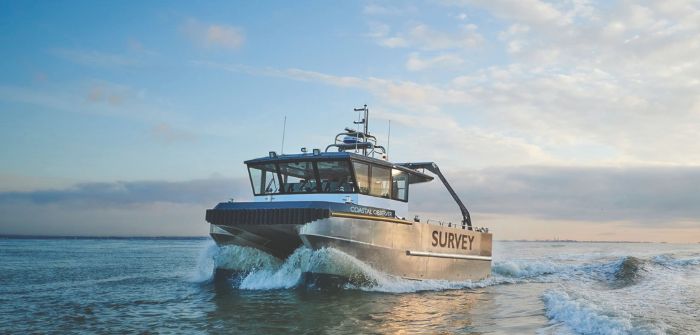
E&H Marine talks to Andy Page, founder and MD of Chartwell Marine, about the first Scanwell hybrid shallow-water survey craft.
There are many excellent reasons for choosing a hybrid design for shallow-water survey craft, not least of which is the reduction of noise interference. So there was great interest when Chartwell Marine, a pioneer in next-generation vessel design, announced the launch of its Scanwell shallow draft survey vessel. Designed for use in a wide variety of applications, including offshore energy, port infrastructure and scientific expeditions, it aims to improve versatility and safety in 1.5m (5ft) waters.
One of the first contracts for the new vessel inverts the usual hybrid paradigm as, according to Andy Page, naval architect and founder and MD of Chartwell Marine, “It’s an electric vessel with a diesel add-on.”
As a result, it’s also a series hybrid rather than the usual parallel configuration found in smaller vessels. Therefore, it’s not the diesel engines that directly provide the bulk of the power; rather the 160kWh energy storage system is central to operations. “That allows us to be far more creative when meeting the various onboard demands,” says Page, “For example, with survey work you’re going at a relatively slow speed, typically carrying out sampling zero or sub-4kts. If you are utilizing a towing array and sonar equipment you might be going as fast as 8kts. In both cases, you want to limit underwater noise.”

The hull of the Scanwell range is aluminum and available in multiple sizes: 10m, 12m, 15m and 19m (33ft, 39ft, 49ft and 62ft). “Using an electric motor and stored energy instead of a diesel engine better dissipates the vibration through the aluminum structure,” says Page, “Which allows for better image processing and greater clarity.”
The reduction of noise interference has another significant benefit for this particular boat: it’s also going to be a classroom for a university research establishment. “Given the drop in onboard noise, we anticipate a much better experience for academics and students,” comments Page.
Survey speed
It’s a roomy design: there’s a large working deck with space and fittings for diving kit, ROV or saturation tester and an A-frame positioned on the transom centerline. Around the perimeter of the single-tier saloon superstructure are lab desks with computer stations and wet zones for processing samples. Usefully, the half-dozen central, forward-facing seats can be removed, leaving just a couple of benches and a more spacious working area.
Next to the saloon is a slightly raised wheelhouse with excellent visibility and access to the open upper-deck behind it, which holds a series of winches. Cleverly, the elevated position allows the cables for towing the 3D mapping array or trawl lines to run straight to the A-frame, keeping clear of the deck and reducing trip hazards.
However, the tunneled aft body contains a skeg-protected, fixed-pitch propeller rather than a waterjet. Page outlines the reasons behind the decision: “While waterjets are very efficient at high speeds and they have some handling advantages, these typically shallow but open areas don’t require that level of maneuverability and waterjets have a little less efficiency at survey speeds.”
That eye to efficiency is necessary given that the power will be sourced primarily from the 80kWh lithium-ion batteries in each hull. These will plug into a shore-power connection at night or, during long transits, pick up a charge from the gensets. Importantly, these smaller, 224kW output, variable speed engines are now demoted to mostly acting as range extenders, power boosts during limited, 10kts speed transits or adding grunt to the power behind the winches during heavy A-frame lifts.
Energy predictions
The result is a highly integrated vessel. “You have to evaluate this boat’s power system as a whole,” notes Page. “For example, the electric-diesel configuration means you’re not limited to fixed drivelines, and so you
can lose a lot of the mechanical complexity in favor of cabling.
“We don’t have a power take-in or gearbox as you’d have on a parallel hybrid; we route everything through to the two 200kW electric motors – an especially useful feature for restricted catamaran hull volumes. Moreover, electrical instead of diesel-driven systems allow us to specify higher quality components and makes things such as bilge pumps and winch drives more efficient and quieter.”
Most importantly, the layout allows the draft to be kept at around 1.5m (5ft), enabling the Scanwell to work in restricted depths that are inaccessible to many other vessels of a comparable size. Furthermore, the design can be configured for parallel hybrid energy storage (or no battery at all) depending on the use case.
As a result, the design promises to appeal to a fairly broad audience. For example, port authorities with a need for surveying severely sedimented channels may well be interested in the 10m, 12m or 15m as well as the 19m version, the boat’s electric-running capability being particularly desirable if they have an environmental agenda to meet. However, Page also points out that the Scanwell design’s larger size enables it to be effective further out to sea. As some of the newer wind farm development zones are located in mudflats and other nearshore, shallow water areas, he expects a certain interest from offshore renewable energy clients.
Still, even the most robust energy storage solutions are challenged by a perennial problem: the lack of a crystal ball. “You have to work extremely hard just to get a realistic evaluation of exactly how a new boat is to be utilized,” he says. “Predictions are usually in place long before the vessel’s even emerged from the yard.”
Batteries have a handy, though largely under-appreciated characteristic. “Instead of setting the energy storage capacity in stone,” he says, “they allow the design to be configured so that once it’s had a year in operation, the owners can decide to add another string of batteries. Fitting another fuel tank is a problem; by contrast, it’ll be relatively simple to add to the energy storage as a better understanding of the operational profile emerges.”
As not many other systems yield this level of flexibility, it would appear that this is yet another plus to add to the ever-growing list of reasons to fully embrace emerging hybrid propulsion technologies in marine applications.
By Stevie Knight