


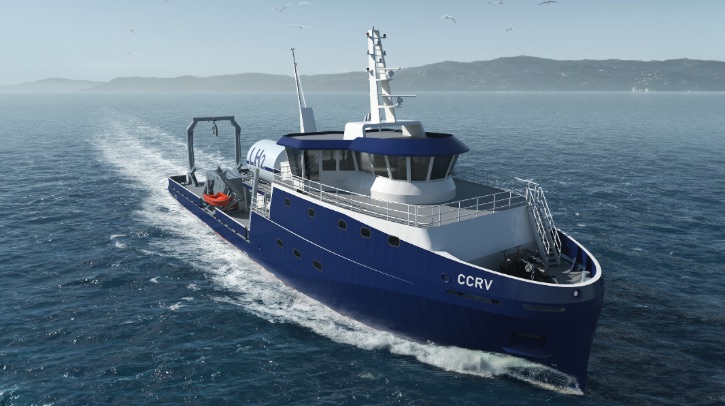
The American Bureau of Shipping (ABS) has approved the preliminary design of a hydrogen-hybrid research vessel that will join the fleet at UC San Diego’s Scripps Institution of Oceanography when completed.
Scripps Oceanography’s California Coastal Research Vessel
The ship will feature a hydrogen fuel cell propulsion system that will enable it to operate with no greenhouse gas or other emissions for 75% of its missions – and for all of its time operating in state waters. For longer missions farther offshore, extra power will be provided by clean-running modern diesel generators.
“Our goal is to produce a fully capable ocean-going research vessel that meets the needs of our scientists and students, and demonstrate that this can be done in a way that absolutely minimizes its impact on our environment,” said Bruce Appelgate, associate director of Scripps and head of ship operations and marine technical support. “This will be a world-class oceanographic research vessel that aligns with our institutional values for protecting the planet.”
The new vessel will replace research vessel Robert Gordon Sproul, which has served thousands of University of California students in its 43 years of service but is nearing completion of its service life.
Technical requirements and safety standards
The 125ft vessel’s design was developed by naval architecture and marine engineering firm Glosten. Approval of the preliminary design shows that it meets technical requirements and safety standards and lays the groundwork for the expanded use of zero-emission hydrogen-powered propulsion at sea.
As one of the first liquid hydrogen-powered ship in the USA, the California Coastal Research Vessel required the development of a new regulatory framework, setting precedents for the technical standards governing the construction and operation of hydrogen-powered ships.
“ABS is proud to use our industry-leading insight into hydrogen as a marine fuel to support this project,” said Gareth Burton, ABS senior vice president of global engineering. “The CCRV has the potential to make a significant contribution to the wider adoption of hydrogen, a promising alternative fuel for the maritime industry.”
During the vessel’s preliminary design, Glosten worked closely with the American Bureau of Shipping as well as the US Coast Guard to inform regulations and ensure the new liquid hydrogen-powered research vessel complied with them.
“Our challenge was to harmonize the requirements of a modern research vessel with evolving regulations and novel technologies for liquid hydrogen fuel. Ensuring the hydrogen systems were safely arranged without compromising the utility of the vessel was like putting together an intricate puzzle,” said Glosten’s Robin Madsen, the lead marine engineer on the project.
California’s sustainability goals
The zero-emission-capable vessel represents a step toward advancing California’s pledge to reduce global climate risk while transitioning to a carbon-neutral economy and making progress toward the University of California’s climate action goals.
In 2021, under Senate President pro Tempore Emeritus Toni Atkins’s leadership, California state legislators allocated US$35m toward the development of the vessel. In March 2023, California Governor Gavin Newsom visited Scripps’s Nimitz Marine Facility to learn more about the vessel.
Of the CCRV, Newsom said, “California continues to lead the way in clean energy innovation, and this vessel is another step in transitioning to a carbon-neutral economy. It’s great to see UC San Diego and Scripps Oceanography lead the hands-on education, training and scientific research we need to tackle the climate crisis.”
Additionally, in the autumn of 2023, the Department of Energy (DOE) chose California as one of seven hydrogen hubs, or regions where the agency will fund coordinated networks of hydrogen fuel producers, purveyors and consumers. A University of California-backed consortium called the Alliance for Renewable Clean Hydrogen Energy Systems (ARCHES), led the state’s application to DOE, and will steer up to US$1.2bn in federal funding toward 39 hydrogen infrastructure projects up and down the state. The California Coastal Research Vessel is considered a Tier 1 marquee project for the hub, eligible to receive additional funding towards the project.
In 2018, Glosten, Sandia National Laboratories, and DNV completed a feasibility study funded by the US Department of Transportation Maritime Administration that became the genesis of CCRV. The study evaluated the technical, regulatory and economic feasibility of the Zero-V concept, a vessel powered by fuel cells and liquid hydrogen designed to meet performance and environmental criteria established by Scripps. The study confirmed that a hydrogen-powered research vessel was possible, and in 2022 the Office of Naval Research supported the preliminary design effort under Award N00014-22-1-2765 (any opinions, findings and conclusions or recommendations are those of the authors and do not necessarily reflect the views of the Office of Naval Research).
The team at Glosten is currently progressing the CCRV to the next phase of its design process and will assist Scripps as it begins its search for a contractor to complete the vessel’s construction.
In related news, the first hydrogen-fueled vessel in the USA recently received US Coast Guard approval to enter commercial service. Click here to read the full story.