


Close Menu
Advanced Maritime Technology International
  • News
    • A-M
      • Battery Technology
      • Environmental
      • Equipment and Services
      • Expo
      • Ferries and Cruises
      • Marine Construction
      • Marine Renewables
    • N-Z
      • Naval Projects
      • Onboard Systems
      • Ports and Harbours
      • Power and Propulsion
      • Shipyards and Shipbuilding
      • Vessel Build and Maintenance
  • Features
  • Online Magazines
  • Opinion
  • Videos
  • Supplier Spotlight
LinkedIn Facebook X (Twitter)
  • Sign-up for Free Weekly E-Newsletter
  • Meet the Editors
  • Contact Us
  • Media Pack
LinkedIn
Subscribe
Advanced Maritime Technology International
  • News
      • Alternative Fuels
      • Autonomous Technology
      • Awards
      • Battery Technology
      • Expo
      • Ferries and Cruises
      • Hydrogen
      • Legislation
      • Motor Technologies
      • New Vessels
      • Onboard Systems
      • Ports and Harbours
      • Power and Propulsion
      • Shipyards and Shipbuilding
      • Vessel Design
  • Features
  • Online Magazines
    1. April 2026
    2. January 2026
    3. September 2025
    4. April/May 2025
    5. January 2025
    6. September 2024
    7. April 2024
    8. Archive Issues
    9. Subscribe Free!
    Featured
    May 5, 2026

    In this issue – April 2026

    Online Magazines By Web Team
    Recent

    In this issue – April 2026

    May 5, 2026

    In this issue – January 2026

    December 4, 2025

    In this issue – September 2025

    August 6, 2025
  • Subscribe
  • Opinion
  • Videos
  • Awards
    • Electric & Hybrid Marine Awards 2025 – Nominations open
    • 2024 Winners
    • 2023 Winners
    • 2022 Winners
    • Previous Winners
  • Supplier Spotlight
  • Expo
LinkedIn Facebook
Subscribe
Advanced Maritime Technology International
Alternative Fuels

Rotterdam study sets out pathway for nuclear-powered commercial ship port calls

Alex PackBy Alex PackJune 12, 20262 Mins Read
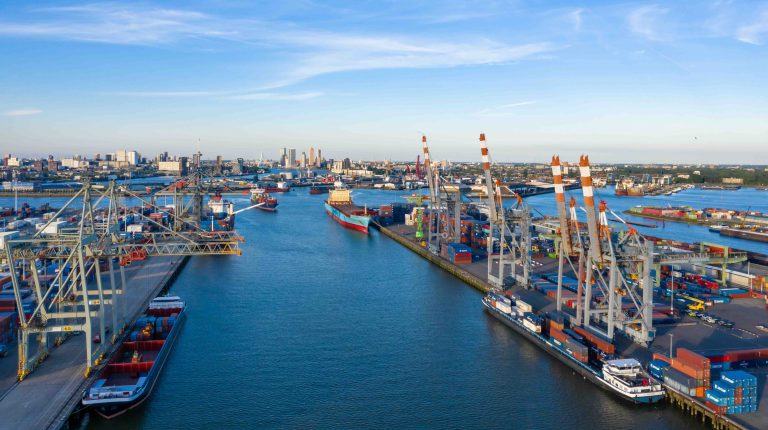
Aerial view of the Port of Rotterdam in the Netherlands.
The Port of Rotterdam in the Netherlands.
Share
LinkedIn Twitter Facebook Email

A joint feasibility study using the Port of Rotterdam as a case study has found that existing port safety and risk-management frameworks could provide a credible starting point for assessing nuclear-powered commercial vessel calls at a major European port.

The desktop study, carried out by Lloyd’s Register, the Port of Rotterdam Authority, Core Power and A P Moller – Maersk, sets out the questions ports, regulators and industry would need to answer to assess nuclear-powered vessels in a structured way. It also identifies further work required before routine operation could be contemplated, including regulatory alignment, emergency preparedness, security, liability and public engagement.

The report argues that maritime nuclear propulsion should be evaluated as part of the wider decarbonisation discussion, noting that some shipping segments may ultimately require propulsion solutions capable of supporting endurance, reliability and operational flexibility at scale – beyond what current alternative fuels such as hydrogen, ammonia and e-fuels can offer.

Among its key findings, the study concludes that IMO provisions relating to nuclear-powered ships were developed for an earlier era and require modernisation, and that European maritime decarbonisation discussions have so far given comparatively limited consideration to high-density, zero-emission propulsion systems.

Core Power CEO Mikal Bøe said public trust would be fundamental to any future deployment: “Together with Rotterdam, LR and Maersk we’ve identified a port safety framework and created a credible starting point for assessments by the IMO as it revises the Safety Code for Nuclear Ships and for the IAEA as it launches its flagship ATLAS program this summer.

“Greenhouse gas emissions from the existing shipping fleet have become unsustainable and have led to the slowest sailing times we’ve seen in decades. Now is the time to start the important work of evaluating nuclear shipping in a modern context.”

Port of Rotterdam harbour master René de Vries said the study was intended to better understand the regulatory, operational and safety considerations associated with nuclear-powered commercial shipping within a European port context.

Ole Graa Jakobsen, vice president, head of fleet technology at A.P. Moller – Maersk, stressed the study did not represent a decision to pursue nuclear propulsion: “This study does not represent a decision to pursue nuclear propulsion, but contributes to further understanding of what would be required for ports and authorities to assess such vessels in a structured and responsible way.”

Related news, European consortium launches €4m project to accelerate maritime retrofits

Share. Twitter LinkedIn Facebook Email
Previous ArticleEuropean consortium launches €4m project to accelerate maritime retrofits

Related Posts

Alternative Fuels

European consortium launches €4m project to accelerate maritime retrofits

June 11, 20263 Mins Read
Alternative Fuels

DP World launches nuclear energy feasibility study at Romania’s Port of ConstanÈ›a

June 8, 20263 Mins Read
Alternative Fuels

Construction begins on liquefied biogas facility at the Port of Gothenburg

May 27, 20262 Mins Read
Latest News

Rotterdam study sets out pathway for nuclear-powered commercial ship port calls

June 12, 2026

European consortium launches €4m project to accelerate maritime retrofits

June 11, 2026

Ecomar and Kuasar partner on 100% emission-free vessel designs

June 10, 2026

Receive breaking stories and features in your inbox each week, for free


Enter your email address:


Supplier Spotlights
  • The Switch
Getting in Touch
  • Contact Us / Advertise
  • Meet the Editors
  • Media Pack
  • Free Weekly E-Newsletter
Our Social Channels
  • LinkedIn
UKi Media & Events
© 2026 UKi Media & Events a division of UKIP Media & Events Ltd
  • Terms and Conditions
  • Privacy Policy
  • Cookie Policy
  • Notice & Takedown Policy

Type above and press Enter to search. Press Esc to cancel.