


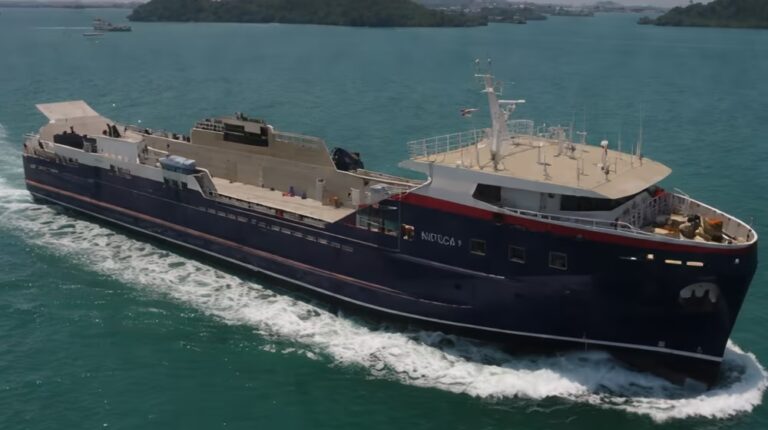
Lloyd’s Register has granted approval in principle (AiP) to Seatransport for a hybrid nuclear-diesel power concept based on the company’s stern landing vessel (SLV) platform.
The AiP recognizes the technical feasibility of integrating advanced nuclear power capability with conventional diesel-electric propulsion within Seatransport’s vessel design.
Approval in principle indicates that the design has undergone an independent preliminary review against safety and regulatory requirements. It does not constitute approval for construction or deployment but confirms that the concept is technically viable from a classification perspective.
The design builds on Seatransport’s more than 25 years of experience developing amphibious stern landing vessels designed for operations in demanding environments. The hybrid nuclear-diesel configuration is intended to explore the potential for longer endurance, reduced reliance on conventional fuel and improved operational resilience.
“We do believe that for all shipowners, this is a paradigm shift in marine technology greater than sail to steam” – Stuart Ballantyne, CEO of Seatransport
According to the companies, the concept integrates advanced nuclear energy capability into an established vessel platform while maintaining a hybrid propulsion approach.
Jez Sims, technical authority for nuclear at Lloyd’s Register, said, “Achieving approval in principle for hybrid nuclear power is an exciting step for LR and the wider maritime industry. We are proud to provide independent technical assurance, drawing on decades of expertise in regulatory compliance, vessel design and nuclear safety. Our role is to help the industry move forward with confidence — turning pioneering ideas into safe, practical solutions.”
Stuart Ballantyne, CEO of Seatransport, said the approval represents a key development for amphibious vessel design: “By working closely with LR, we’ve integrated nuclear MMR capability into our proven SLV platform, future-proofing it for extended endurance, operational flexibility and low-emission performance. We do believe that for all shipowners, this is a paradigm shift in marine technology greater than sail to steam.”
Seatransport said the milestone reflects its ongoing involvement in research into emerging maritime technologies and its efforts to assess new energy systems within practical vessel designs.
Related news, YYachts begins production of first hybrid-powered Y8