


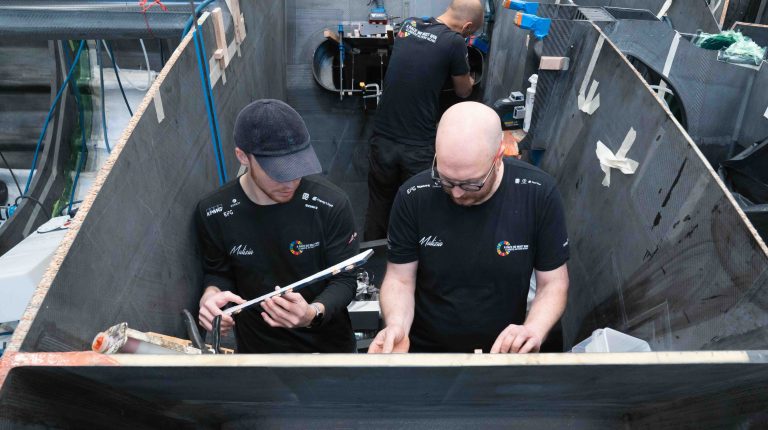
Team Malizia has unveiled its new IMOCA race yacht, the Malizia 4, which is equipped with an optimised hybrid-electric propulsion and energy system featuring a Molabo electric motor, Fischer Panda generator and Solid State Marine batteries.
Onboard energy management has become a critical design and performance factor for IMOCA teams, as modern offshore racing yachts rely on navigation, communications, autopilot systems, sensors, onboard computing, safety equipment and media systems while operating for weeks or months at sea.
Team Malizia technical consultant Jesse Rowse said weight and efficiency were the top priorities for the new installation, which drew on on experience gained from the team’s first Molabo hybrid installation aboard Malizia-Seaexplorer: “For the next generation, the two biggest priorities were weight and maximum efficiency. The Molabo motor that makes the whole hybrid package possible is so small and compact, it gives us much more flexibility in the overall system architecture.”
Unlike the first installation, which had to be fitted into the space previously occupied by a diesel engine, the new system’s layout was optimized from the start. “The system itself is quite similar, but the physical layout is very different,” Rowse said. “This time, because we already knew the system worked, we could optimize the layout from the start.”
Team Malizia estimates the hybrid installation delivers significantly more usable energy than a conventional diesel system using the same amount of fuel – a factor Rowse said is increasingly important as IMOCA and race organizers tighten fossil fuel limits. Future Vendée Globe competitors will be restricted to 60 liters of fuel.
“With the new rule, everyone can carry the same amount of fuel, but with this system we can get roughly twice as much energy from those 60 liters,” Rowse said. “Without a highly efficient system, teams will have to make compromises elsewhere, whether that means reducing communications, using hydrogenerators more often, or adding more solar panels and weight.”
Rowse also pointed to reliability as a key lesson from the first system. “We never had a problem with the Molabo motor,” he said. “The motor always did what it was supposed to do.”
Despite hybrid systems costing more than conventional diesel installations, Rowse said the trade-off is worthwhile. “I would choose the hybrid system over a diesel system every day,” he said. “It gives you flexibility, efficiency and advantages in how you design the boat.”
Rowse said interest in hybrid systems is growing across the IMOCA fleet and sees broader applications for offshore sailing, describing hybrid propulsion as a practical bridge between diesel and fully electric operation.
Adrian Patzak, COO at Molabo, said the partnership has informed the new system’s design: “The confidence and knowledge gained from the first system allowed the design team to improve layout, efficiency, and ultimately sailing performance in their new yacht. That is exactly how advanced marine electrification should evolve.”
Related news, SpiritBARTech F35 sets early benchmark in newly electric Harmsworth Trophy