


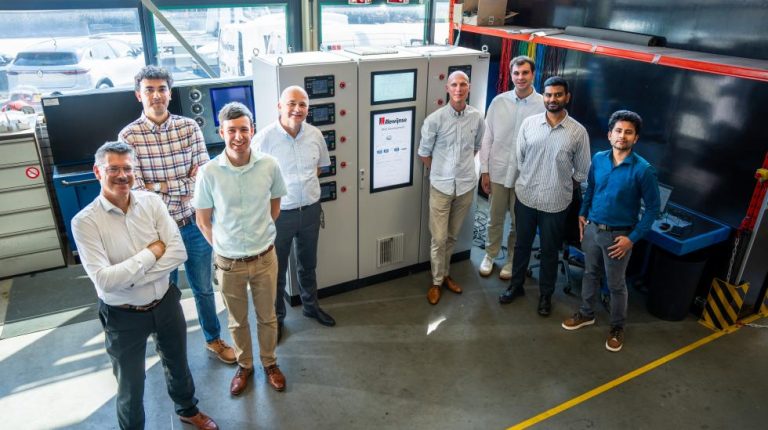
Alewijnse and the University of Twente are collaborating to advance the application of hardware-in-the-loop (HIL) technology in the maritime sector, combining academic expertise in power electronics and energy systems with Alewijnse’s maritime engineering and system integration experience to accelerate development and validation of vessel electrification solutions.
The collaboration began through the master’s thesis of Petar Vuckovic, a University of Twente student conducting his research at Alewijnse. Vuckovic is contributing to the development of a Typhoon HIL solution for electrical systems, enabling energy management System (EMS) algorithms to be validated in real time. His research focuses on system integration and the stability of power management systems (PMS) in a DC environment, a component that monitors and regulates voltage across electrical systems.
Zoran Malbasic, senior R&D systems engineer at Alewijnse, said the company is pioneering HIL applications in the maritime sector. His R&D team, led by Mischa Habermehl, includes graduate students from Delft University of Technology and has recently expanded to include students from the University of Twente’s Power Electronics group, led by Professor Thiago Batista Soeiro.
“We complement each other perfectly,” Malbasic said. “While the University of Twente excels in research on power electronics, electromagnetic interference (EMI), electrical machines and battery storage systems, Alewijnse brings in-depth expertise in the practical implementation and system integration of maritime energy systems. This combination allows new ideas to be tested and further developed more quickly.”
Malbasic added that both organizations’ use of Typhoon HIL allows for knowledge exchange in modeling electrical systems: “Hardware-in-the-loop enables us to validate energy management strategies and electrical systems before implementation on board vessels, helping us reduce development risks and accelerate innovation in maritime electrification.”
The maritime sector is shifting toward electrification, with shipowners and shipyards increasingly adopting hybrid vessels using batteries, fuel cells and biofuel cells, driven by stricter climate requirements from the IMO, EU, national governments and classification societies.
“To remain relevant, we must continue to invest in technologies such as power conversion and DC grid solutions,” said Malbasic. “Collaboration with universities helps us to develop targeted new insights and attract talent.”
Vuckovic said the role offers a unique opportunity, noting he previously completed an internship at Alewijnse on solid-state circuit breakers and DC grid protection before starting his thesis on power management in DC systems in January.
Related news, Yamaha develops outboard material that cuts motor moulding time by 20%