


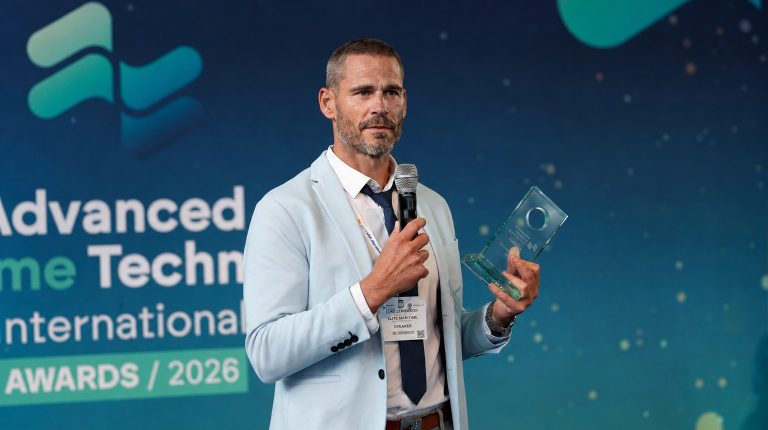
The new issue of AMTI includes an article about the winners of this year’s Advanced Maritime Technology International Awards, which were presented in Amsterdam in June. As you might expect from such a group of talented innovators, many had more to say about their achievements than we had space for in the magazine – so, in the first of a series of extended interviews, we hear more from the winners of the 2026 awards. Our first expanded article features an interview with Luke Jenkinson, group CEO and founder of Elire, which took home the Ports and Harbors Innovation of the Year award for its H2 Marine Power Hubs – a maritime energy-to-power solution that acts like an off-grid microgrid
What does it mean to you and the team to win this award?
It’s a significant moment for everyone involved. Awards like this are never about one company or one individual; they’re recognition of the collective effort across an exceptional consortium of engineers, technology partners and industry specialists who have worked together to solve a very real challenge facing ports today.
More importantly, it’s recognition that the industry increasingly sees maritime infrastructure innovation as being just as important as vessel innovation in delivering maritime decarbonization. We believe clean energy infrastructure needs to become faster to deploy, more flexible and commercially practical, and it’s encouraging to see that vision being recognized internationally.
Is it satisfying to see the design be so well received?
Absolutely. What’s particularly rewarding is that the recognition isn’t simply for an interesting, innovative concept; it’s for a solution built around technologies that already exist today.
From the outset, our focus wasn’t on inventing entirely new technologies. It was about integrating hydrogen, storage, battery systems, fuel cells and intelligent energy management into a deployable infrastructure platform that ports can realistically adopt.
The feedback we’ve received reinforces that the market is looking for practical solutions that address today’s infrastructure constraints rather than waiting for perfect conditions in the future.
You’ve shown great ingenuity in applying this technology to a marine ‘problem.’ What are some of the next milestones for the design?
The next stage is about moving from validation toward deployment.
We’ll continue refining the platform, strengthening commercial partnerships and ensuring the solution can be deployed efficiently across different port environments.
As the energy-to-power system is containerized, this project demonstrates an integrated total of 24 x 20ft [7.3 x 6m] containers to 1,200m² of platforms (hubs).
Elire Maritime is continuing to think smarter by developing an interchangeable design for the containers. This includes adopting and integrating hydraulic skid systems on the decks, allowing for seamless interchanging of containers from a barge to a platform without the need for cranes.
The energy-to-power systems we support are energy agnostic; this system integrates hydrogen, and we will look at other alternative fuels like methanol (MeOH) to power as well.
This system also demonstrates a 5MW profile for cold ironing and connecting a small cruise vessel, where our systems can scale to integrate higher-profile energy-to-power systems that can include 10, 20, 30MW. We will work with partners and clients to design these for different applications.
Now it becomes simply designing to requirements.
Our objective has always been to create a scalable infrastructure model that ports can adopt incrementally, allowing them to begin reducing emissions and supporting electrification without waiting years for major grid reinforcement projects.
You’ve mentioned the potential for this technology in other sectors – just how far do you see this going?
The opportunity extends well beyond vessel connection power and cold ironing.
At its core, the solution is a modular, grid-independent energy platform, so wherever there’s demand for clean power, the floating energy-to-power systems can also provide power to shoreside.
Other applications include offshore wind operations, powering floating data centers, logistics hubs, remote industrial facilities, island communities, defense applications and distributed energy networks where conventional infrastructure is difficult or expensive to deliver.
We see this as part of a broader shift toward flexible energy infrastructure. As hydrogen markets continue to mature, platforms capable of generating, storing and delivering clean power where it’s needed will become increasingly valuable across multiple sectors, not just maritime.
Advanced Maritime Technology International Awards 2026 – winners announced!