


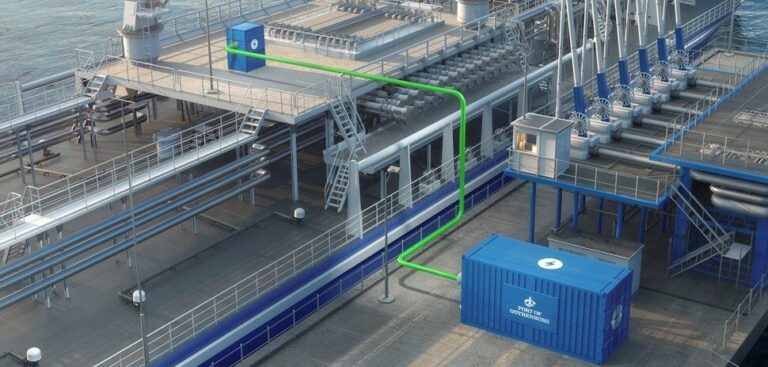
The Gothenburg Port Authority has announced plans to provide shoreside power for tankers berthed at the Energy Terminal. The concept aims to make the system safe, environmentally friendly and cost-effective.
Working in collaboration with shipping companies on the island of Donsö, national and European ports, classification societies, local oil companies and the Swedish Transport Agency, the group aims to set a new global standard for shoreside power for tankers berthed in hazardous environments.
“The greatest challenge is to ensure that tankers that are scheduled to be built are fitted with shoreside power connectors that adhere to a common standard applied at all ports,” said Jörgen Wrennfors, Gothenburg Port Authority production engineer at the Energy Terminal.
“A further challenge is the constant risk of an explosion when the vessel is berthed at an energy terminal as the combustible and flammable products being pumped could easily be ignited by a spark from the electrical equipment. These challenges have become an intrinsic part of our planning strategy.”
At quay 712 at the Port of Gothenburg in the ro-ro terminal, vessels now benefit from green power by cable, enabling polluting diesel engines to be shut off during loading and unloading. Despite this, designing a shore power solution for tankers at the Energy Terminal has not been an easy task for the port, said Wrennfors: “When tankers are at sea their classification specifies that a power supply point can only be located aft of the bridge. Vessel designers have used this as a starting point when designing new vessels fitted with shoreside power connectors.
“However, this classification does not apply when the tanker arrives at an energy terminal. In the majority of cases it is superseded by the port’s classification, which means the entire vessel is deemed to be an explosive atmosphere, including the aft.”
A downside of having the power supply point at the aft is that the length of vessels varies greatly, with many vessels over 150m-long and quays which are considerably shorter. Locating a power connector at the aft would require the ports to build connection cranes at the quayside to reach the connector. This would result in long cables being required with complicated and expensive cranes to lift them. Instead of adapting each port, the Port of Gothenburg has come up with an alternative resolution.
“The standard we are proposing puts the power connection point in the center of the vessel and we are in the process of formulating a technical requirement specification for shipbuilders to implement this novel approach,” explained Wrennfors. “As all tankers have their loading crane in the center of the vessel this would be the optimal solution for lifting the power cable on board. As a result, the length of the vessel would no longer be an issue and the direction in which she docks is irrelevant. We regard this as the best technical solution and it offers substantial cost savings at each berth.”
Despite the location of the power connector being agreed, there is still the issue of power needing to be supplied in an explosive atmosphere.
“Volatile and highly combustible gases that are present during bunkering and the risk of sparks during connection is a dangerous combination,” said Wrennfors. “We have now resolved the problem by working with overpressure in the spaces where the cable is housed and connected. This solution will shut out any explosive gases, making the facility safe.”
When talking about persuading the international shipping community to recognize the underlying benefits of the new standard, Wrennfors added, “Bringing about a change in underlying assumptions is essential. It is vital that major ports, oil companies, public authorities and classification societies are included to ensure we have a new standard in place that everyone adheres to. A solution is currently being produced here at the Port of Gothenburg and we are leading by example. It is our hope that this will be noted and incorporated into international standardization procedures in the future.”