


Close Menu
Advanced Maritime Technology International
  • News
    • A-M
      • Battery Technology
      • Environmental
      • Equipment and Services
      • Expo
      • Ferries and Cruises
      • Marine Construction
      • Marine Renewables
    • N-Z
      • Naval Projects
      • Onboard Systems
      • Ports and Harbours
      • Power and Propulsion
      • Shipyards and Shipbuilding
      • Vessel Build and Maintenance
  • Features
  • Online Magazines
  • Opinion
  • Videos
  • Supplier Spotlight
LinkedIn Facebook X (Twitter)
  • Sign-up for Free Weekly E-Newsletter
  • Meet the Editors
  • Contact Us
  • Media Pack
LinkedIn
Subscribe
Advanced Maritime Technology International
  • News
      • Alternative Fuels
      • Autonomous Technology
      • Awards
      • Battery Technology
      • Expo
      • Ferries and Cruises
      • Hydrogen
      • Legislation
      • Motor Technologies
      • New Vessels
      • Onboard Systems
      • Ports and Harbours
      • Power and Propulsion
      • Shipyards and Shipbuilding
      • Vessel Design
  • Features
  • Online Magazines
    1. April 2026
    2. January 2026
    3. September 2025
    4. April/May 2025
    5. January 2025
    6. September 2024
    7. April 2024
    8. Archive Issues
    9. Subscribe Free!
    Featured
    May 5, 2026

    In this issue – April 2026

    Online Magazines By Web Team
    Recent

    In this issue – April 2026

    May 5, 2026

    In this issue – January 2026

    December 4, 2025

    In this issue – September 2025

    August 6, 2025
  • Subscribe
  • Opinion
  • Videos
  • Awards
    • Electric & Hybrid Marine Awards 2025 – Nominations open
    • 2024 Winners
    • 2023 Winners
    • 2022 Winners
    • Previous Winners
  • Supplier Spotlight
  • Expo
LinkedIn Facebook
Subscribe
Advanced Maritime Technology International
Battery Technology

Wattlab launches standardized battery system for inland shipping

Alex PackBy Alex PackJune 2, 20262 Mins Read
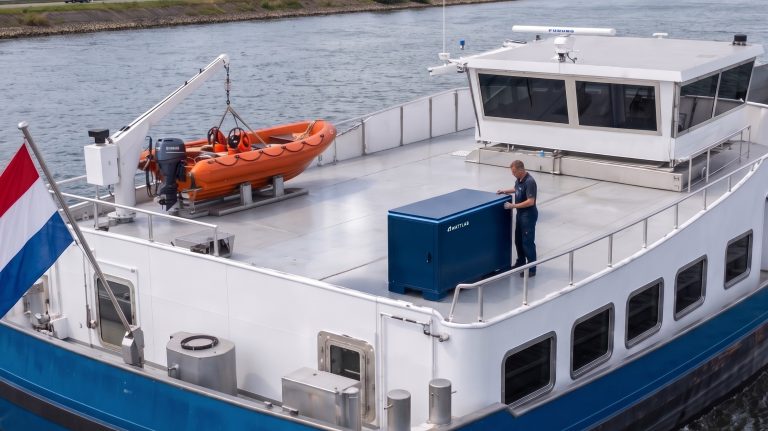
Wattlab WeStack battery pack on the deck of a ship.
Image credit: Wattlab
Share
LinkedIn Twitter Facebook Email

Rotterdam-based Wattlab has introduced WEstack, a standardized battery system for inland shipping vessels that the company says can be installed within a single working day.

The system is designed to address what Wattlab identifies as a key barrier to decarbonization in the sector: the high cost and lengthy installation times of conventional marine battery systems. Where traditional systems are typically custom-built and require several weeks of installation work, WEstack arrives fully assembled and tested, needing only to be connected once on board.

The technology targets a fundamental inefficiency in how inland vessels currently operate. “Generators on vessels operate most of the time at only 10%-15% of their capacity,” said Bo Salet, founder and CEO of Wattlab. “That is extremely inefficient. At low loads, a generator consumes relatively large amounts of fuel. By adding a battery pack, the generator can charge the battery at its optimal operating point, after which the battery supplies power to the vessel.”

Wattlab says WEstack can reduce generator running hours by 80% to 90%, delivering fuel savings, lower maintenance costs and reduced COâ‚‚ emissions. The system also reduces onboard noise, vibrations and exhaust fumes.

WEstack is available in four standard capacities – 100kWh, 200kWh, 300kWh and 400kWh – a deliberate design choice that enables faster production and keeps costs below those of custom-built alternatives. The unit is installed on the aft deck and is suited to both new-build and retrofit applications across a range of vessel types, including dry cargo ships, tankers and small coastal vessels.

Salet also pointed to growing pressure from ports as a driver of adoption: “More and more ports want to reduce emissions and noise pollution. With a battery system, vessels can operate silently and emission-free for much longer periods without relying on shore power.”

Founded in 2017, Wattlab initially developed solar energy systems for the maritime sector, gaining recognition for large-scale solar installations on inland vessels. The company is also currently developing Solar Flatrack systems for seagoing vessels.

Salet framed energy efficiency as the more immediate path to emissions reduction compared to alternative fuels: “Alternative fuels are likely to remain scarce and expensive for the foreseeable future. That is why we believe energy efficiency is the fastest and most cost-effective route to reducing emissions in the sector.”

Related news, Corvus Energy and BYD Energy Storage sign agreement on maritime battery development

Share. Twitter LinkedIn Facebook Email
Previous ArticleIndustry coalition calls on governments to remove barriers to offshore-wind vessel charging

Related Posts

Autonomous Technology

DLR celebrates keel-laying of Modularis seagoing technology platform

May 21, 20263 Mins Read
Motor Technologies

ABB to acquire Specialtrasfo to expand transformer offering

May 19, 20262 Mins Read
Battery Technology

Corvus Energy and BYD Energy Storage sign agreement on maritime battery development

May 13, 20261 Min Read
Latest News

Wattlab launches standardized battery system for inland shipping

June 2, 2026

Industry coalition calls on governments to remove barriers to offshore-wind vessel charging

June 1, 2026

All American Marine delivers hybrid passenger vessel to Harbor Breeze Cruises

May 29, 2026

Receive breaking stories and features in your inbox each week, for free


Enter your email address:


Supplier Spotlights
  • OSWALD Elektromotoren GmbH
Getting in Touch
  • Contact Us / Advertise
  • Meet the Editors
  • Media Pack
  • Free Weekly E-Newsletter
Our Social Channels
  • LinkedIn
UKi Media & Events
© 2026 UKi Media & Events a division of UKIP Media & Events Ltd
  • Terms and Conditions
  • Privacy Policy
  • Cookie Policy
  • Notice & Takedown Policy

Type above and press Enter to search. Press Esc to cancel.