


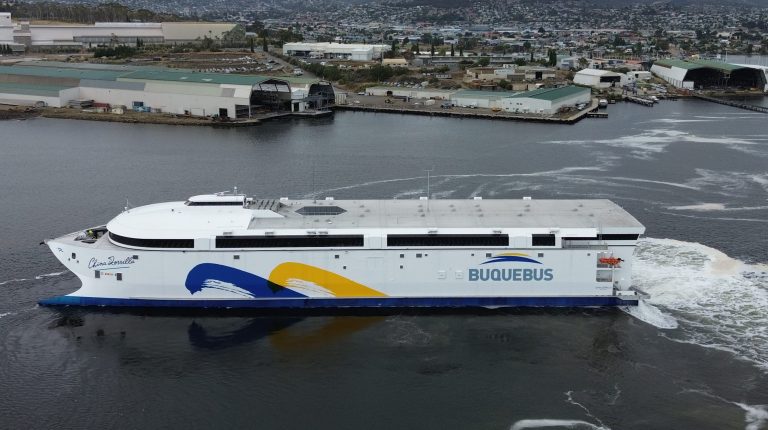
When the 130m China Zorrilla enters service this year for Uruguayan operator Buquebus on the Buenos Aires-Colonia del Sacramento route, it will do so as the world’s largest fully electric ferry. With capacity for up to 2,100 passengers and more than 225 vehicles, the Incat-built vessel is powered by a battery system exceeding 40MWh – the largest ever installed on a ship.
The vessel’s top speed of around 25kts is comparable to conventional fast ferries operating the same route, and its overall vessel weight is marginally less than an equivalent LNG-powered configuration would have been, because aluminum catamaran hulls combined with the elimination of heavy LNG fuel tanks and cryogenic equipment offset the weight of the 250-ton battery room.
This isn’t a vessel that has traded performance for environmental credentials. It’s a fully commercial ship, operating on a competitive route, that happens to produce zero direct emissions.
Shifting the commercial paradigm
The China Zorilla matters because it shifts the conversation. Electric ferries are past being a novelty. The market is already worth several billion dollars and is expected to grow at double-digit rates through the 2030s. Meanwhile, port-level zero-emission mandates are tightening globally. For operators, continuing to build fossil-fuel dependencies means risking future obsolescence and getting locked out of key green corridors.
Moreover, passenger preference for sustainable travel continues to grow. So, the direction of travel is clear – the industry’s task now is to replicate at scale across the broader fleet.
It’s not only a battery story
Progress in battery technology has been substantial. Lithium-ion energy density has improved by roughly 40% over the past five years, while costs, size and weight continue to fall. These developments have significantly lowered the barriers to electrification.
But scaling from small hybrid vessels to large, fully electric ferries is not just a matter of batteries. It requires a fundamentally different approach to electrical system design. High power demand, peak loads and fast acceleration place significant stress on the system, which must simultaneously be efficient, reliable, compact and flexible.
This is where the power architecture becomes a defining factor.
The case for DC distribution
For vessels with large battery systems, DC distribution is widely considered the most logical solution. Batteries are inherently DC, and most modern onboard loads – drives, converters and electronic systems – operate on DC internally. A DC system minimizes conversion losses, reduces footprint, improves redundancy and enables seamless integration of energy storage and alternative energy sources (including wind and solar).
AC-based architectures introduce additional conversion steps, increasing losses and requiring larger battery capacity to compensate. At multi-MW scale, those losses are significant, translating directly into increased weight, volume and system complexity. For large electric ferries, where optimization matters at every level, DC distribution is the natural answer.
The safety challenge at scale
As vessel size and battery capacity increase, so does the energy on board – and with it, the potential consequences of electrical faults. In DC networks, fault currents rise rapidly and don’t naturally drop to zero as they do in AC systems. Protection devices must respond instantly and selectively, isolating faults without disrupting overall system operation.
This is the central technical challenge of large-scale maritime electrification. Meeting it requires purpose-built power electronics capable of acting not in milliseconds but in microseconds.
On the China Zorrilla, for example, this was addressed through an integrated suite of ultrafast protection devices – electronic current limiters, battery short-circuit limiters and electronic DC breakers – built into the vessel’s DC distribution system. These devices isolate faults at lightning speed, preventing cascading failures and enabling ride-through capability: if a fault occurs in one part of the system, the vessel continues operating. At 40MWh, that capability is not optional – it’s the condition that makes safe operation possible.
Flagship for what comes next
The China Zorrilla demonstrates that scale, performance and safety can be achieved together. But it is best understood as a reference point (it confirms that large-scale electric ferries are no longer theoretical) rather than an endpoint. The technology exists and is proven in commercial operation.
Looking ahead, the same system architecture that makes a 40MWh ro-pax viable could extend to container vessels, offshore construction ships and retrofit projects for comparable ferry types. As battery technology and power electronics continue to evolve, the case for large-scale electrification will only accelerate – and the maritime industry will be cleaner and more efficient for it.
What is required is the right combination of system integrators, technology partners and operators prepared to move.