


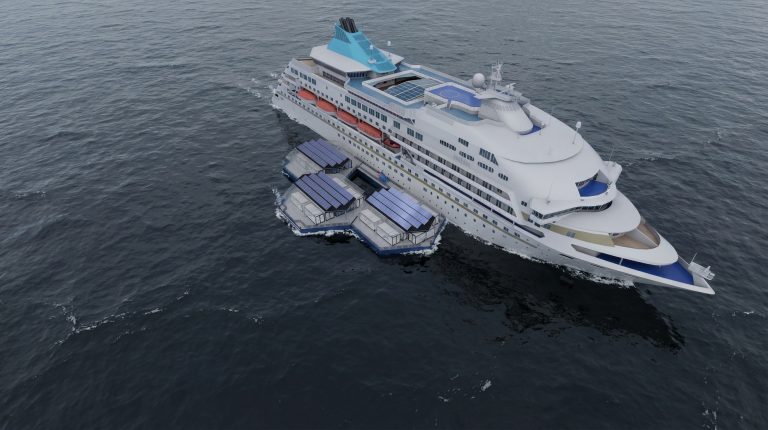
A UK consortium led by ELIRE Maritime has completed a £1m (US$1.35m) feasibility program validating what it describes as one of the world’s first fully grid-independent floating hydrogen power hub systems capable of delivering clean power directly to vessels at berth.
The project was backed by a grant through the UK government’s Clean Maritime Demonstrator Competition Round 6 (CMDC6) program, funded by UKRI and delivered by Innovate UK in partnership with the UK Shipping Office for Reducing Emissions (UK SHORE). Partners in the consortium are Ricardo UK, Schneider Electric, Rux Energy UK, Triton Anchor Europe, the Offshore Renewable Energy Catapult (OREC), and the University of Strathclyde.
The validated system is said to be able to deliver 5MW of continuous clean power output to vessels at berth, sufficient to support medium-size cruise vessels and other large maritime assets requiring 6.6kV and 11kV shore power connections. It comprises three modular hexagonal floating platforms with a combined 1,200m2 footprint, approximately 45MWh of battery energy storage, modular fuel cell systems, hydrogen-powered generation, onboard solar generation of up to 146kW, and advanced grid-forming AC/DC electrical architecture.
The system can deliver approximately 91MWh of energy per week and uses around 7,500-8,000kg of hydrogen weekly, stored in modular ISO-compatible low-pressure containers.
Rather than relying on oversized generators, the platform uses modular 1.3MW fuel cells operating continuously to charge onboard batteries, which then dispatch energy rapidly when vessels arrive.
“Think of it as charging a giant floating battery throughout the week and then releasing that energy rapidly when the vessel arrives,” said Luke Jenkinson, founder and CEO of ELIRE Maritime. “That changes the economics and deployment model for maritime electrification.”
The system is designed to bypass one of the primary obstacles to port decarbonization: grid access. Traditional shore power infrastructure can take between three and seven years to deliver, involving substation upgrades, civil works and complex permitting. By situating energy infrastructure on water, the hub avoids these constraints entirely.
“Ports do not need to wait years for grid upgrades to begin reducing emissions,” said Jenkinson. “We have validated a practical, scalable and deployable system capable of delivering clean power directly where it is needed most.”
Emissions analysis led by Ricardo UK found the system can reduce vessel emissions at berth by approximately 77% compared to conventional onboard diesel generation, potentially eliminating around 47 metric tons of CO₂ per vessel per week. The consortium estimates a global addressable market of approximately 62TWh annually for grid-independent maritime energy solutions.
Current energy costs are estimated at £0.25-£0.50/kWh (US$0.34-US$0.67/kWh), compared to conventional shore power at £0.15–£0.25/kWh (US$0.20-US$0.34/kWh), though the consortium expects costs to fall as hydrogen pricing and manufacturing scale improve.
ELIRE Maritime is progressing discussions for deployments across the UK, Australia and Europe, and is seeking partners including ports, infrastructure investors, vessel operators and hydrogen suppliers to accelerate commercial rollout.
Related news, Magnetic system enables wireless offshore charging of electric vessels