


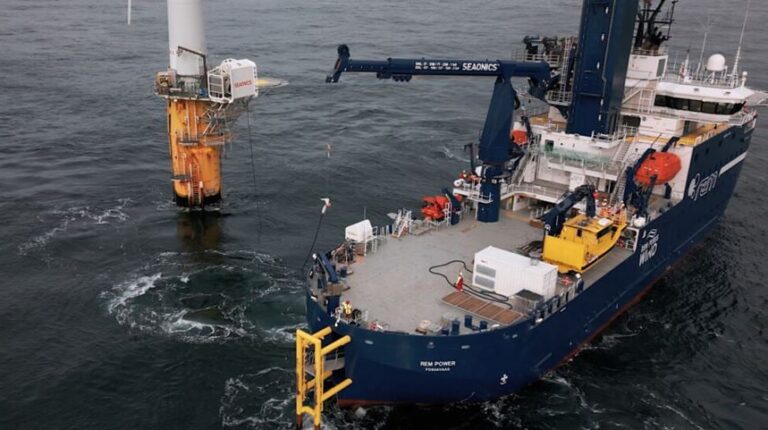
A new inductive charging solution has enabled charging of electric vessels offshore without physical cable connections, addressing one of the key challenges for battery-powered maritime operations.
Developed as part of the Ocean Charger project, led by Vard and with research support from SINTEF, the system uses magnetic fields rather than traditional plug-based connections to transfer power.
The approach is designed primarily for service operation vessels (SOVs) supporting offshore wind farms, but could also be applied to other vessel types such as platform supply vessels.
Traditional offshore charging systems rely on physical connectors, which are vulnerable to corrosion, wear and mechanical stress in harsh marine environments. According to Vard, these factors increase maintenance requirements, costs and operational risk.
The new system replaces exposed metal contacts with inductive charging coils sealed within durable, waterproof materials. Power is transferred wirelessly when the coils on the vessel and charging station are brought into close proximity.
“We’ve looked at a lot of solutions here,” said Giuseppe Guidi, senior research scientist at SINTEF. “We’ve tested a possible solution that works almost like a regular electrical contact. But we can avoid all the problems because we transfer the power inductively by encapsulating the plug itself in materials that can withstand just about anything.”
The design reduces the need for precise alignment during connection. “It won’t be necessary to be precise when lowering the plug into the receiver hole,” Guidi added. “It’s almost like putting a cup in a cup holder. It will fit no matter which way it is turned. Very plug and play.”
The system requires multiple integrated components, including power conversion from alternating current to direct current, high-voltage transmission through flexible cables, and conversion to high-frequency current for inductive transfer. On board, systems then convert and route the energy into the vessel’s batteries.
Researchers focused on coil design and control systems to maximize efficiency and minimize energy loss. The aim is to achieve performance comparable to conventional charging while improving durability and reducing maintenance.
“The genius of charging at sea in this way is that the electrical energy produced locally is used directly to charge the ships, which ensures that very little energy is wasted,” said Håvard Vollset Lien, project manager at Vard.
The system can also be integrated with offshore substations, enabling energy generated by wind turbines to be stored and used for vessel charging without requiring a return to port.
Developers say the technology could support the expansion of offshore charging infrastructure, particularly along coastlines with significant offshore energy production.
Related news, HD Hyundai advances electric propulsion technology for large vessels