


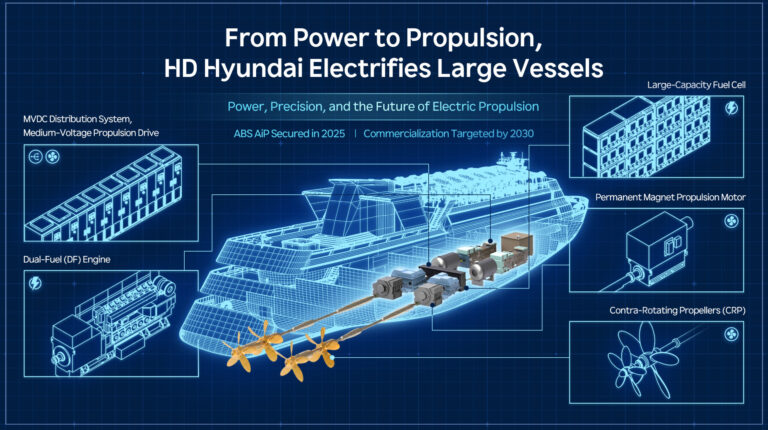
HD Hyundai is developing a full electric propulsion platform for large commercial ships, as the industry explores alternatives to conventional fuel-based systems to reduce emissions.
Electrification of large vessels presents significant challenges compared to road transportation, particularly due to the need to carry heavy cargo over long distances without opportunities for recharging. This has led shipbuilders to focus on systems that generate electricity on board using alternative fuels such as hydrogen, natural gas and ammonia.
HD Hyundai’s approach is based on an integrated system covering power generation, distribution and propulsion.
For power generation, the company is developing an “energy mix power system” that combines dual-fuel engines (DFGE) with ammonia-based solid oxide fuel cells (SOFC). The dual-fuel engines are designed to respond to fluctuations in onboard power demand, while SOFC systems generate electricity through electrochemical reactions rather than combustion, improving efficiency and reducing energy loss.
According to the company, the use of SOFC technology also supports compliance with tightening emissions regulations by offering a lower-carbon alternative to traditional marine engines.
In the distribution phase, HD Hyundai is focusing on medium-voltage direct current (MVDC) systems. These systems transmit electricity at voltages between 1.5kV and 100kV and are intended to improve efficiency compared to conventional alternating current systems by reducing energy loss. The company said MVDC could improve overall energy efficiency by up to 20% in large electric vessels.
HD Hyundai is working with the American Bureau of Shipping (ABS) to develop design standards and regulatory frameworks for MVDC systems. The companies signed a memorandum of understanding in May 2024 to support this work.
The final stage of the system is propulsion, for which HD Hyundai is developing a medium-voltage propulsion drive based on a modular multilevel converter structure. This technology enables precise control of motor speed and torque, supporting stable operation under varying conditions, including low-speed maneuvering and rapid acceleration.
The company said it has secured core technologies for propulsion drives that were previously imported, enabling it to localize the full electric propulsion platform – from power generation through to propulsion. Commercialization of the propulsion drive is planned for 2028.
HD Hyundai has also received an approval in principle from ABS for the concept design of a 16,000 TEU container ship equipped with an electric propulsion system. The company is targeting commercialization of large electric-powered vessels by 2030.
Related news, Electric propulsion trial launched for commercial fishing in Maine