


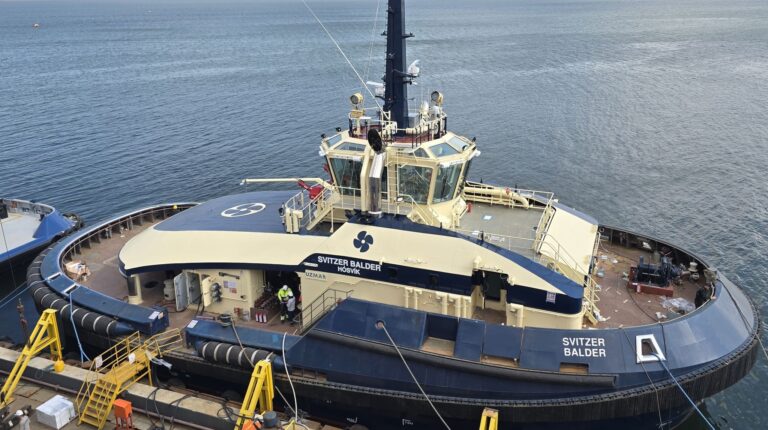
Marine battery manufacturer AYK Energy has reported a milestone in the electrification of workboats following the completion of sea trials for what it describes as the first battery-methanol harbor tug.
The vessel, Svitzer Balder, was built by Uzmar Shipyard and is set to be delivered to the Port of Gothenburg. According to AYK Energy, it will be capable of performing more than 90% of towing and docking operations using a battery electric powertrain, operating in near-zero-emission mode.
The tug is described as the most powerful electric escort tug to date, designed for both harbor duties and near-open ocean operations. It is the fifth vessel operated by Svitzer to be equipped with battery systems from AYK.
AYK supplied the vessel with an ABS-certified Aries A 6MWh battery system, which is expected to have a lifespan of around 10 years. The company also supported sea trials for the tug.
Chris Kruger, founder of AYK Energy, said the project reflects the rapid development of marine battery technology. “AYK is proving that battery technology is evolving and becoming more powerful, more advanced and more competitive. At a time of volatile oil prices, battery power is offering an increasingly attractive safe harbor to vessel operators,” he said.
Kruger highlighted the role of lithium-iron-phosphate (LFP) cells in improving the economics and safety of marine batteries. “This project again shows that LFP can provide the energy density and horsepower the industry demands for significantly less cost and it is much safer than the more combustible NMC chemistry,” he said.
The Svitzer Balder features a transverse tug design developed by Svitzer and combines its battery system with dual-fuel methanol engines, which provide backup power and extend operational range.
AYK said it is seeing growing demand for its battery systems across multiple vessel types, including ferries, cruise ships, fishing vessels, workboats and container ships.
The battery system for the tug was manufactured at the company’s automated facility in Zhuhai, China, which opened in 2023 with an annual production capacity of 300MWh, scalable to 1GWh.
In related news, China tests first all‑electric container ship, said to be world’s largest