


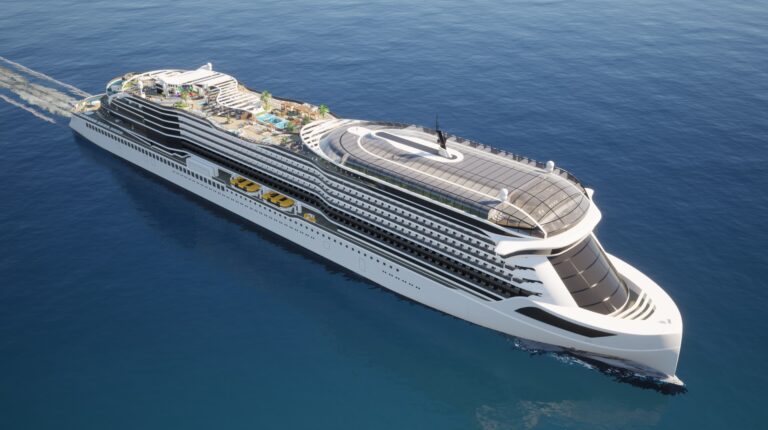
Meyer Werft will present a concept study for a 100% battery-electric large cruise ship – which it says is the first of its kind – at Seatrade Cruise Global 2026, running April 13-16 in Miami, Florida.
Project Vision is 275m long, accommodates 1,856 passengers, and has a size of around 82,000 GT – with a reported reduction in greenhouse gas emissions of up to 95%.
Tim Krug from the Meyer Werft concept development group said, “We asked ourselves how we can use innovation to reduce CO₂ and contribute to decarbonization – not in 50 years, but much sooner.”
Johannes Bade, responsible at Meyer Werft for the development program behind Vision, added, “With battery‑electric cruise ships, we offer a competitive product that relies on existing technologies. We are opening up entirely new opportunities for our customers to operate sustainably and profitably in the long term.”
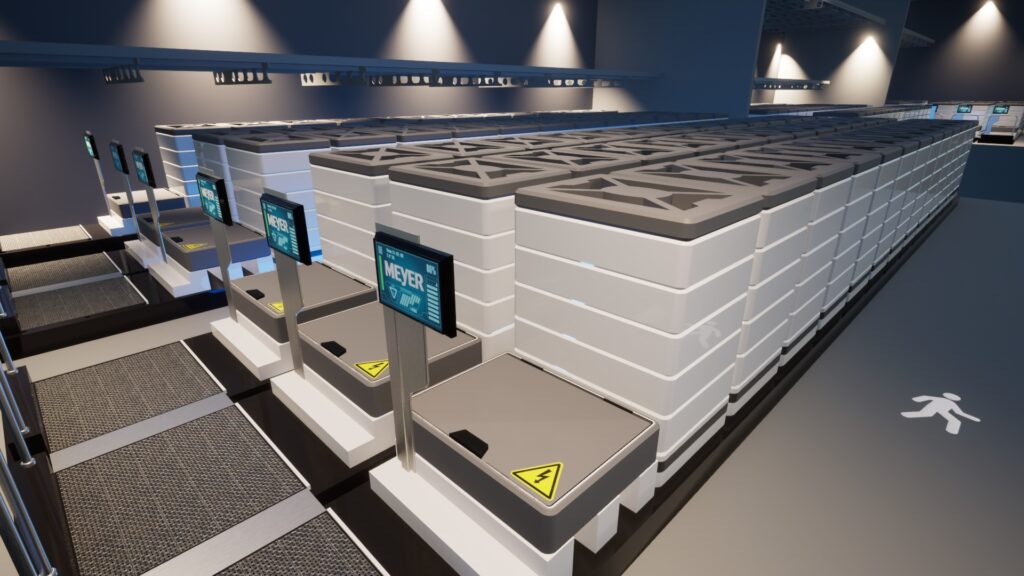
The battery system, supplied by Corvus Energy, enables a large portion of typical European cruise routes to be covered, such as the route from Barcelona to Civitecchia near Rome.
Fredrik Witte, CEO of Corvus Energy, said, “Our close collaboration with Meyer Werft and the combination of our capabilities demonstrated with the Vision is the natural evolution of battery technology – and a defining moment for the cruise industry. Scaling to fully electric cruise ships shows the world that the technology is safe, mature and ready to change the game.”
Meyer Werft said that by 2030, around one hundred ports across Europe will offer the required charging infrastructure.
Upon request, the ships can also be built as hybrids with small generators, enabling, for example, transatlantic crossings.
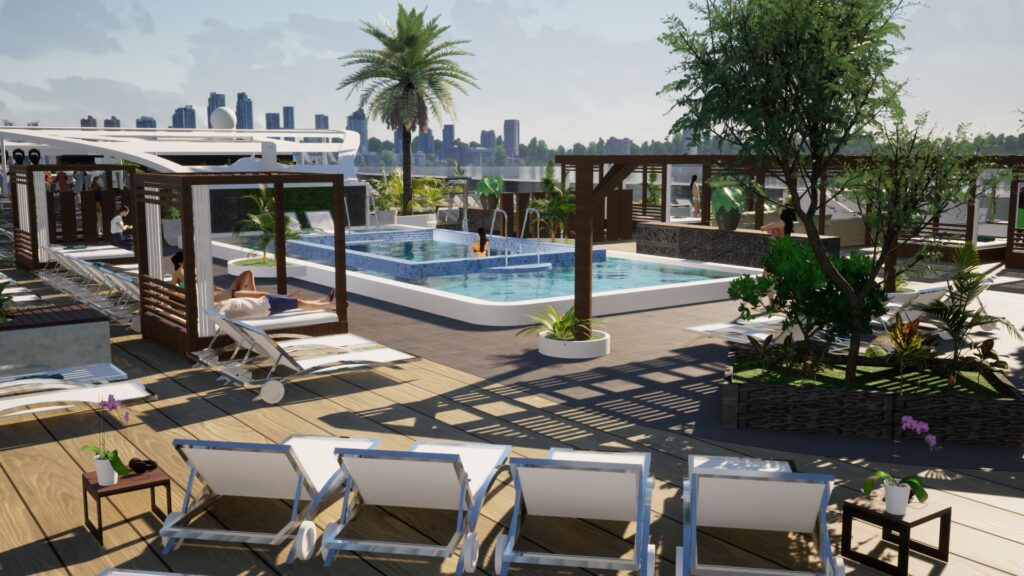
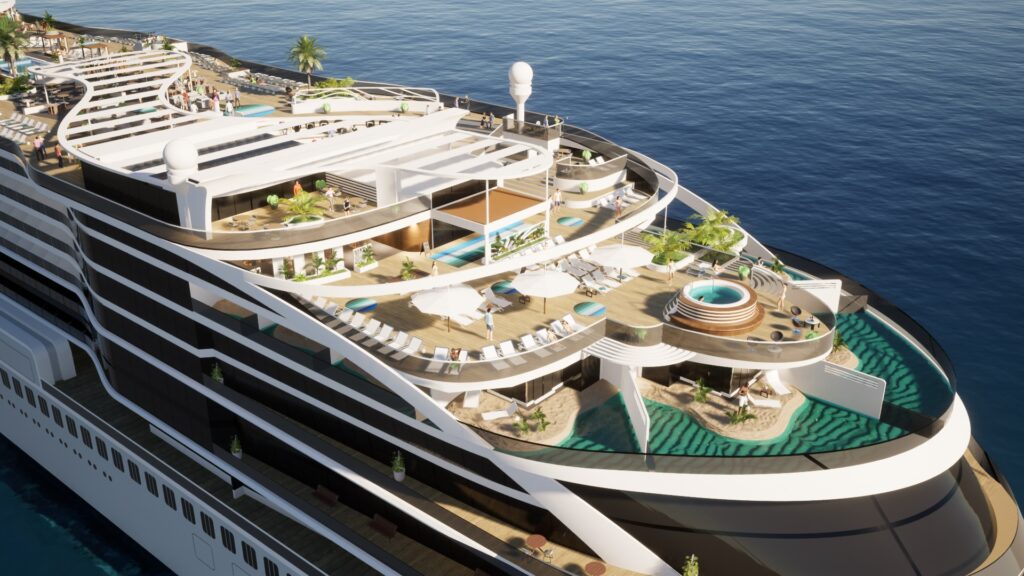
Project Vision also introduces new architectural approaches to cruise ship design. For example, the vertical shaft running through the ship for exhaust treatment and the funnel – which usually occupies parts of the sun deck – can be eliminated. This enables an entirely new sun deck design (above) with unobstructed views.
The Vision concept study is designed as an all‑weather ship and includes fully glazed, weather‑protected areas. For example, the typical aqua park has been arranged as an indoor area at the stern, making it usable year‑round.
Another advantage of the fully electric battery design is that by eliminating the main engines, onboard comfort for passengers can be improved through the reduction of engine noises and vibrations.
Related news, Boreal orders 20 Candela electric hydrofoil ferries