


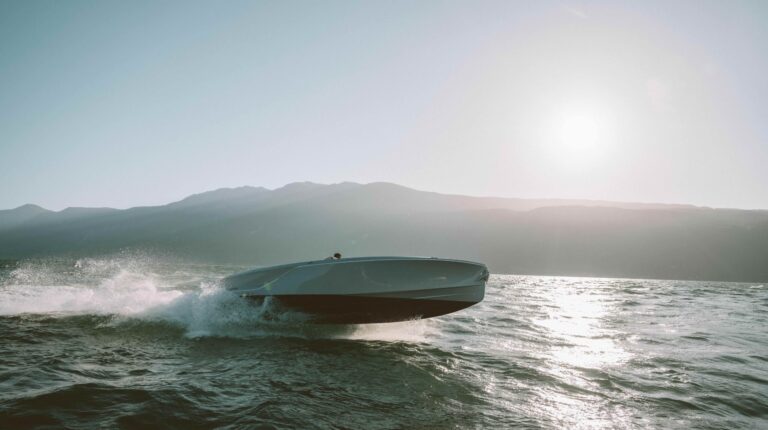
Porsche, Porsche Engineering and Austrian boatbuilder Frauscher have jointly developed the 850 Fantom Air, an electric sports boat powered by components derived from the Porsche Macan Turbo.
The 8.5m vessel uses key elements of the Macan Turbo’s 800V rear axle drive system, including the battery and drive module, adapted for marine use. According to the companies, the project moved from design stage to first prototype in under a year and has since been prepared for series production.
Porsche led the project, with Porsche Engineering responsible for technical implementation. “Only through close and trust-based cooperation with the individual specialist departments of Porsche have we succeeded, in just two years, in implementing a development that is ready for series production,” said Thomas Warbeck, a specialist project manager at Porsche Engineering.
Instead of a conventional gasoline or diesel engine, the 850 Fantom Air features a permanently excited synchronous motor delivering up to 400kW. The boat can reach speeds of more than 85km/h. Power comes from a 100kWh lithium-ion battery system mounted in the hull.
While core electrical components such as the stator and rotor were adopted unchanged, the motor housing was redesigned to meet marine standards. In contrast to automotive applications, the motor operates at around 6,000rpm, eliminating the need for an internal gearbox. A standard Z-drive reduces propeller speed to approximately 3,000rpm.
“We have developed and tested the new housing specifically to marine standards in terms of material selection and pairings, for example by means of adapted tests for salt spray, corrosion and leaks,” said Sebastian Riesbeck, specialist project engineer at Porsche Engineering.
Engineers also addressed differences in load profiles between road and marine environments. Boats typically operate under high continuous loads, requiring enhanced cooling. The team implemented optimized pump actuation and adapted mounting systems to manage vibration and exposure to saltwater.
To simplify integration, the developers introduced a modular concept comprising a drive unit with cooling and control modules, and a separate battery unit with a support frame. “This modularization represents a solution that is unique worldwide, being one that leads to lower development costs for the manufacturer of the boat and considerably simplifies the installation of the drive in the boatyard,” said Riesbeck.
A gateway control module was developed to interface automotive powertrain components with marine systems, including rest-bus simulation to replace vehicle-specific signals not present in boats.
Frauscher has begun manufacturing a limited series of 25 boats. According to the company, the electric powertrain could also be adapted for other vessel sizes, including larger boats using multiple parallel systems.
Related news, Ribcraft unveils electric version of Pro 480 RHIB