


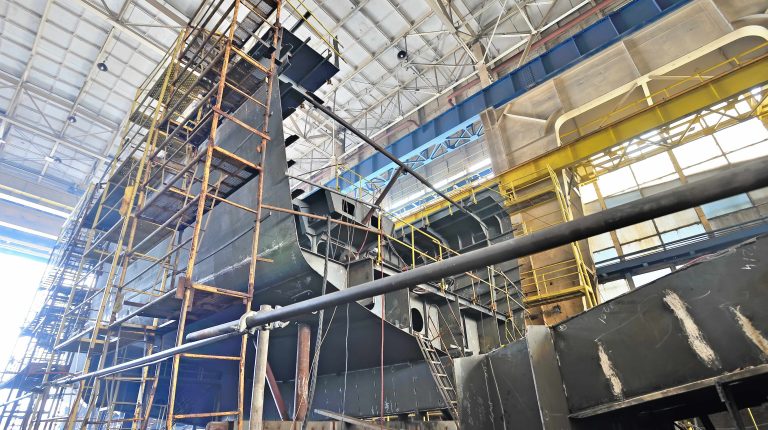
Researchers in the USA and Japan are developing robotic and AI systems to help shipbuilders identify and respond to deviations from planned designs during construction.
Led by the University of Michigan Engineering, the project aims to create a system that compares the structure of a ship as it is being built with its original digital design.
The initiative is supported by a US$6.2m grant from Japan’s Ministry of Land, Infrastructure, Transport and Tourism and is expected to run through early 2027.
During ship construction, internal components such as pipes, cables and equipment are often installed under changing schedules, which can lead to conflicts with the original design. In some cases, parts may no longer as intended, requiring rework that can delay delivery.
The research team is developing robots that can move through partially built ships, collecting lidar and camera data. This information will be combined with other measurements and processed by AI models to create a digital representation of the vessel as built. The system will then compare this model to the original design and identify discrepancies.
“We want to build a co-pilot system that uses AI and robotics to sake some of the detective work off worker’s shoulders,” said Alan Papalia, assistant professor of naval architecture and marine engineering at the University of Michigan and principal investigator of the US team. “The system should automatically map what’s installed, identify where reality is drifting from the design, and suggest workable alternatives when something needs to change.”
When issues are detected, the system is designed to generate reports highlighting mismatches and suggesting potential solutions, including trade-offs. This could enable shipyard workers to address problems earlier or adjust plans before conflicts escalate.
The project focuses particularly on outfitting which involves installing systems inside the ship. This stage can involve hundreds of thousands of components in confined and evolving spaces, making it difficult to maintain alignment with initial plans.
To train the AI models, researchers will simulate shipbuilding processes to create synthetic datasets and conduct interviews with shipyard workers in the USA and Japan. The aim is the ensure the system reflects real-world decision-making and provides practical recommendations.
The project is overseen by the Monohakobi Technology Institute, part of NYK Line, and includes collaboration with the Massachusetts Institute of Technology and several Japanese universities.
Hideyuki Ando, managing director of the Monohakobi Technology Institute, said, “We wanted to partner with the University of Michigan because of their unique status as a high-output research university with a dedicated department for naval architecture and marine engineering.”
The system will be tested using a reconfigurable physical model of a ship section, enabling researchers to replicate different construction stages and scenarios.
Related news, Corvus Energy and BYD Energy Storage sign agreement on maritime battery development