
As the maritime sector accelerates the adoption of alternative fuels and advanced energy-saving technologies, onboard systems are becoming more complex, and the need for immediate expert guidance is increasing. Evolving regulations and a stronger focus on compliance make quick support essential for crews to navigate operational and regulatory challenges. Reliable connectivity in machinery spaces, combined with established remote support infrastructure, creates new opportunities to support crews with faster decision-making and safer operations.
“With the industry transitioning to new technologies and the rapid advancements in remote communication tools, now is the ideal time to integrate remote connectivity into real-time support services,” says Jesper Boman, vice president, head of vessel operations at Alfa Laval. “Through investments in next-generation service capabilities, we are expanding digitally enabled support for our customers. By connecting onboard crews directly with shore-based technical experts, we enable real-time collaboration that helps crews operate new and complex equipment with confidence.”
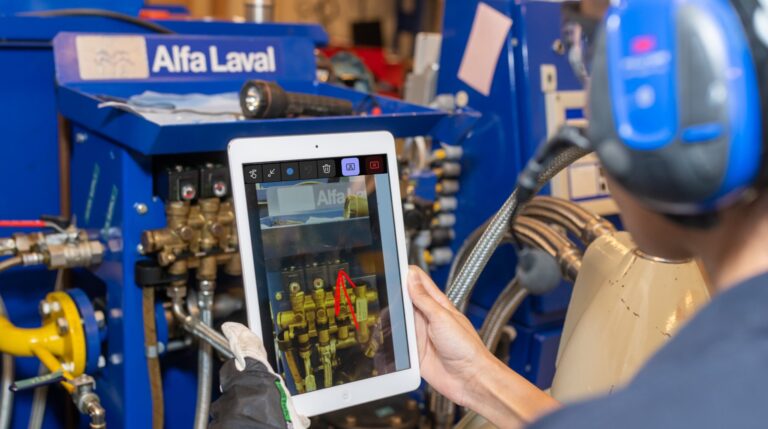
Remote AR guidance can be used to minimize equipment downtime, boost operational efficiency, and enhance crew safety. It can also be used to limit service travel, lower costs and emissions, and support efficient, compliant and reliable vessel operations.
For many years, Alfa Laval has developed and tested installed gateways on key equipment, including ballast water management systems (BWMS), fuel and lube oil purifiers, and oily water separation systems, to enable data-driven troubleshooting, performance improvements and secure regulatory compliance.
Until recently, the limited availability of reliable deep-sea connectivity restricted the ability of ocean-going vessels to fully leverage these capabilities. Today, improvements in satellite communications and onboard network technology are making reliable connectivity at sea far more accessible.
In collaboration with Maersk, Anglo-Eastern and Everllence PrimeServ, Alfa Laval has explored how onboard networks can be extended into machinery spaces to enable real-time monitoring and remote support of critical equipment. Field trials have validated multiple use cases, including troubleshooting, crew training, operational guidance and product evaluation. Tests also confirmed that only minor hardware investment is required to bring key engine-room equipment online, creating a practical foundation for scalable remote services.
“Through extensive field tests conducted across various use cases, the joint project with our partners successfully validated the effectiveness of augmented remote support on board vessels,” said Søren Helmuth Jensen, SVP technology development, business unit marine solutions, Alfa Laval. “These trials enabled support teams to collaborate remotely with crews and customers from any land-based location, accelerating issue resolution, generating valuable learnings for all stakeholders.”
The first step involves combining connected equipment with augmented reality to strengthen remote troubleshooting and crew support. By enabling remote experts to collaborate visually with onboard crews, equipment issues can be resolved faster and more efficiently.
“By using AR guidance, our remote experts can see exactly what the crew sees and guide them step-by-step through complex tasks. We’ve already applied AR-supported remote assistance in real onboard cases, including boiler emergency operation, manual discharge of a separator, assessing the status of a freshwater generator (FWG), and troubleshooting a methanol fuel supply system,” said Søren.
Related news, First fully electric harbor tug in Southeast Asia delivered