


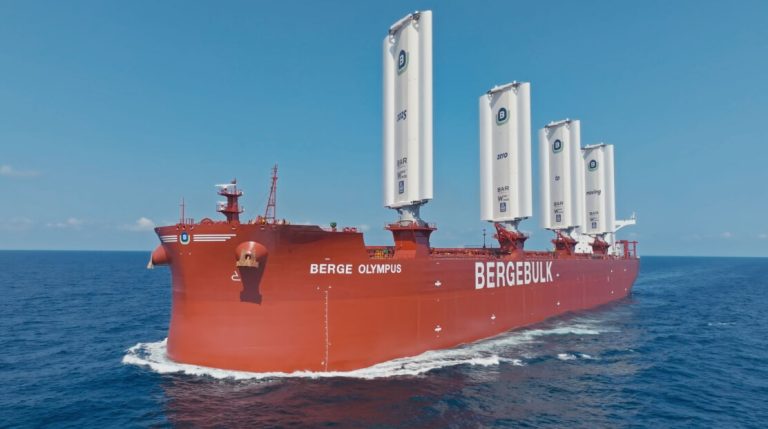

As dual-fuel new-builds are increasingly viewed as a hedge against fuel risk, BAR Technologies CEO John Cooper argues the real hedge is burning less fuel, whatever it turns out to be.
There has been an interesting shift in the discussion around dual-fuel vessels.
They were largely sold as part of shipping’s decarbonization story. Increasingly, they are discussed in financial terms as a hedge against an uncertain energy future.
I understand that completely.
Perhaps it is the accountant in me coming back to my roots, but I still tend to look at these decisions in terms of risk, return and where the exposure sits. When you are committing capital to an asset that could still be operating in 25 or 30 years, and nobody can tell you with certainty what fuel it will be using, optionality has real value.
Geopolitics has made that even more obvious. Energy security matters. Fuel availability matters. Price volatility matters. Regulation matters.
But if I were signing off that investment today, I would want to ask a second question. What can I do to reduce my exposure whichever way the market goes?
We spend a lot of time debating which fuel will win. I am not convinced an owner needs to win (and certainly not lose) that bet.
The latest ordering figures show why. Alphaliner reported that dual-fuel ships accounted for 72% of container capacity ordered in the first 10 months of 2025, down from 81% in 2024 and 83% in 2023. Methanol’s share fell from 18% in 2024 to 12%, while conventionally fuelled tonnage increased to 28%.
That does not mean shipping is turning its back on decarbonization. Of the 131 ships above 10,000 TEU ordered, only 10 were conventionally fueled. What it tells us is that picking a fuel remains difficult.
Alphaliner also reported that Maersk and CMA CGM had publicly stated they were struggling to secure sufficient, affordable methanol. And there is a particularly important point in its analysis. Whether many of the dual-fuel vessels being ordered actually operate on alternative or conventional fuel will depend on fuel availability after delivery.
You can buy the ability to burn two fuels. You cannot buy certainty about what either of those fuels will cost in 10 or 20 years, or whether they will be readily available wherever your vessel trades.
That is why I think we need to look at the other side of the equation. Use less fuel. For me, the sensible answer in an uncertain market is to combine fuel flexibility with technologies that reduce how much fuel you need in the first place.
It sounds obvious, but it changes the risk considerably. If your vessel runs on LNG, reduce the amount of LNG it needs. If it runs on methanol, reduce the methanol. If another fuel emerges and becomes the preferred option, reduce that too.
The fuel can change. The value of needing less of it does not.
That is where wind propulsion becomes interesting beyond the decarbonization argument. At BAR Technologies, our WindWings use wind to contribute to the vessel’s propulsion directly, reducing the load on the main engine and, in turn, its fuel consumption.
Of course, that cuts emissions. But look at it through the numbers and there is another benefit. Every metric ton of fuel you do not burn is a metric ton you do not have to buy. And if future low-carbon fuels are more expensive or harder to secure than today’s fuels, that saving becomes more valuable, not less.
This is not an argument against dual-fuel vessels. Quite the opposite. I think the two approaches make sense together.
Fuel flexibility protects you against choosing the wrong fuel. Fuel efficiency protects you against the cost and availability of all fuels.
It shows that owners are already thinking beyond emissions and looking at these investments in terms of resilience, optionality and financial risk. We should apply the same thinking to efficiency.
Nobody knows exactly what will happen at the IMO, which fuels will scale fastest, where infrastructure will be built or what the next geopolitical shock will do to energy markets. I certainly would not pretend to know which fuel will dominate shipping in 2040.
But there is one thing I would be prepared to bet on.
Whatever that fuel is, whatever it costs and wherever it comes from, a shipowner will be better off needing less of it. The good news is that we already have technologies available to help them do exactly that.