

Close Menu
Advanced Maritime Technology International
  • News
    • A-M
      • Battery Technology
      • Environmental
      • Equipment and Services
      • Expo
      • Ferries and Cruises
      • Marine Construction
      • Marine Renewables
    • N-Z
      • Naval Projects
      • Onboard Systems
      • Ports and Harbours
      • Power and Propulsion
      • Shipyards and Shipbuilding
      • Vessel Build and Maintenance
  • Features
  • Online Magazines
  • Opinion
  • Videos
  • Supplier Spotlight
LinkedIn Facebook X (Twitter)
  • Sign-up for Free Weekly E-Newsletter
  • Meet the Editors
  • Contact Us
  • Media Pack
LinkedIn
Subscribe
Advanced Maritime Technology International
  • News
      • Alternative Fuels
      • Autonomous Technology
      • Awards
      • Battery Technology
      • Expo
      • Ferries and Cruises
      • Hydrogen
      • Legislation
      • Motor Technologies
      • New Vessels
      • Onboard Systems
      • Ports and Harbours
      • Power and Propulsion
      • Shipyards and Shipbuilding
      • Vessel Design
  • Features
  • Online Magazines
    1. January 2026
    2. September 2025
    3. April/May 2025
    4. January 2025
    5. September 2024
    6. April 2024
    7. Archive Issues
    8. Subscribe Free!
    Featured
    December 4, 2025

    In this issue – January 2026

    Online Magazines By Web Team
    Recent

    In this issue – January 2026

    December 4, 2025

    In this issue – September 2025

    August 6, 2025

    In this issue – April/May 2025

    May 14, 2025
  • Subscribe
  • Opinion
  • Videos
  • Awards
    • Electric & Hybrid Marine Awards 2025 – Nominations open
    • 2024 Winners
    • 2023 Winners
    • 2022 Winners
    • Previous Winners
  • Supplier Spotlight
  • Expo
LinkedIn Facebook
Subscribe
Advanced Maritime Technology International
Environmental

eFoiler ferry developer Artemis Technologies installs mHIL simulator in Northern Ireland

Lawrence ButcherBy Lawrence ButcherMarch 8, 20213 Mins Read
Share
LinkedIn Twitter Facebook Email

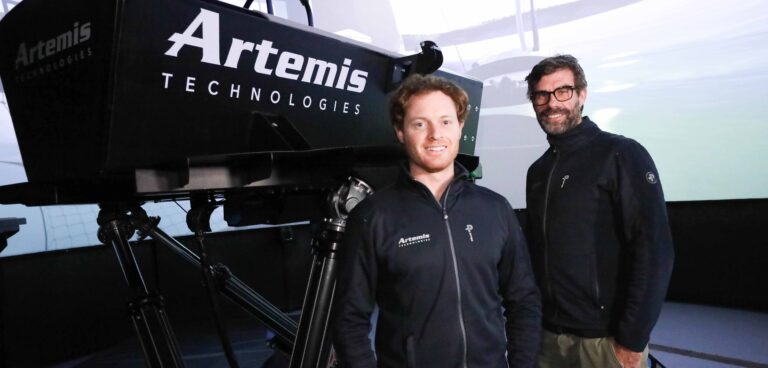
Artemis Technologies, which is leading a program to develop a new class of zero-emission high-speed vessels, has relocated its mechanical hardware-in-the-loop (mHIL) simulator to Northern Ireland, where the vessels are to be developed. The company says it will use the mHIL simulator to streamline the development process and prototyping of its eFoiler electric propulsion system.

Company CEO, Iain Percy, revealed the installation of the simulator ahead of the upcoming America’s Cup yacht race, of which he is a four-time veteran. “We originally built the simulator for Artemis Racing taking part in the America’s Cup, and are hugely excited to bring this incredible technology to Northern Ireland. There is nothing else like this in the world, it’s the most advanced of its kind, and it’s right here. Behind the device is all our collective learning, over 10 years and hundreds of millions of pounds in investment, learning about the marine environment and how vessels operate in that environment. The result is when we want to test something new, like a zero-emission vessel, we can confidently do that.”

The mHIL simulator features a 4.5m-high, 210° screen, which conveys images from three laser phosphor projectors, wrapped around a physical platform similar to those used for flight and motorsport simulators, providing an incredibly immersive experience.

It forms part of Artemis Technologies’ roadmap to creating a high-tech maritime innovation hub in Northern Ireland and will be an integral part of the digital twin of the zero-emission workboat and ferry projects with support from the Belfast Maritime Consortium.

Percy explained, “With the Belfast Maritime Consortium, we are trying to create a number of world firsts: the first-ever zero-emission high-speed fast ferry. As this has never been done before, by definition you need a digital twin. It is a representation of all the same physical forces you experience on the water, including the wind, the waves, the boat itself and how it performs. Out of that, we create a digital environment where we can test new equipment, we can train crew and improve the whole system, without actually having to build anything.

“The net result of a digital-twin manufacturing environment is huge productivity gains. Where you used to have to produce a number of different prototypes followed by learning from your mistakes, now you can literally test tens of thousands of prototypes in the digital world to arrive at the optimal solution, before you have to make anything physical. The power of the digital twin is lower cost, better product, reduced waste, in a shorter time.”

Share. Twitter LinkedIn Facebook Email
Previous ArticleFPS embarks on retrofitting of cargo vessel with hydrogen propulsion
Next Article Torqeedo and Poseidon partner on electric ferry propulsion system

Related Posts

Power and Propulsion

Princeton University tests Kilo Hydro at Mercury Racing’s Lake X

March 24, 20263 Mins Read
New Vessels

First fully electric harbor tug in Southeast Asia delivered

March 19, 20262 Mins Read
Equipment and Services

Alfa Laval expands AR-enabled remote support to boost vessel performance and compliance

March 19, 20263 Mins Read
Latest News

Bureau Veritas classes two advanced high-speed all-electric trimarans

March 24, 2026

Princeton University tests Kilo Hydro at Mercury Racing’s Lake X

March 24, 2026

Joint study shows path to green ammonia cost parity

March 19, 2026

Receive breaking stories and features in your inbox each week, for free


Enter your email address:


Supplier Spotlights
  • Baltic Workboats AS
Getting in Touch
  • Contact Us / Advertise
  • Meet the Editors
  • Media Pack
  • Free Weekly E-Newsletter
Our Social Channels
  • LinkedIn
UKi Media & Events
© 2026 UKi Media & Events a division of UKIP Media & Events Ltd
  • Terms and Conditions
  • Privacy Policy
  • Cookie Policy
  • Notice & Takedown Policy

Type above and press Enter to search. Press Esc to cancel.