

Close Menu
Advanced Maritime Technology International
  • News
    • A-M
      • Battery Technology
      • Environmental
      • Equipment and Services
      • Expo
      • Ferries and Cruises
      • Marine Construction
      • Marine Renewables
    • N-Z
      • Naval Projects
      • Onboard Systems
      • Ports and Harbours
      • Power and Propulsion
      • Shipyards and Shipbuilding
      • Vessel Build and Maintenance
  • Features
  • Online Magazines
  • Opinion
  • Videos
  • Supplier Spotlight
LinkedIn Facebook X (Twitter)
  • Sign-up for Free Weekly E-Newsletter
  • Meet the Editors
  • Contact Us
  • Media Pack
LinkedIn
Subscribe
Advanced Maritime Technology International
  • News
      • Alternative Fuels
      • Autonomous Technology
      • Awards
      • Battery Technology
      • Expo
      • Ferries and Cruises
      • Hydrogen
      • Legislation
      • Motor Technologies
      • New Vessels
      • Onboard Systems
      • Ports and Harbours
      • Power and Propulsion
      • Shipyards and Shipbuilding
      • Vessel Design
  • Features
  • Online Magazines
    1. January 2026
    2. September 2025
    3. April/May 2025
    4. January 2025
    5. September 2024
    6. April 2024
    7. Archive Issues
    8. Subscribe Free!
    Featured
    December 4, 2025

    In this issue – January 2026

    Online Magazines By Web Team
    Recent

    In this issue – January 2026

    December 4, 2025

    In this issue – September 2025

    August 6, 2025

    In this issue – April/May 2025

    May 14, 2025
  • Subscribe
  • Opinion
  • Videos
  • Awards
    • Electric & Hybrid Marine Awards 2025 – Nominations open
    • 2024 Winners
    • 2023 Winners
    • 2022 Winners
    • Previous Winners
  • Supplier Spotlight
  • Expo
LinkedIn Facebook
Subscribe
Advanced Maritime Technology International
Battery Technology

Corvus to supply ESS for world’s first hybrid crew transfer SES

Wesley DoyleBy Wesley DoyleNovember 27, 20192 Mins Read
Share
LinkedIn Twitter Facebook Email

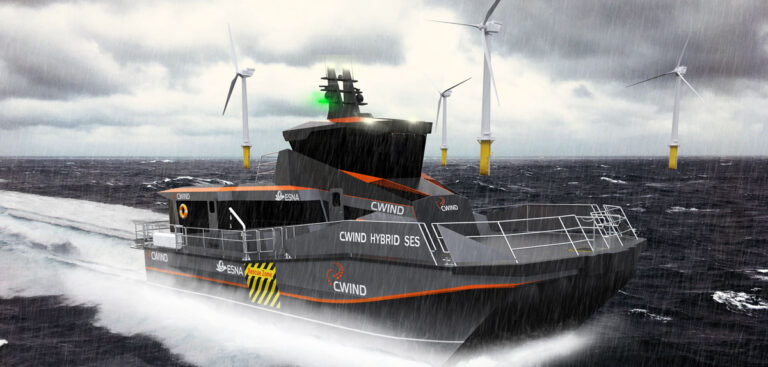
Corvus Energy has announced a new contract with SEC Marine, UK, to supply the energy storage system (ESS) for the world’s first hybrid surface effect ship (SES) for crew transfer.

The development of the 22m hybrid SES for use as a crew transfer vessel is in response to an industry-wide push to develop and deploy technologies that reduce CO2  emissions, while cost-effectively servicing windfarms located offshore.

The vessel design has been developed in partnership with the operator CWind and ESNA, a ship design company based in Kristiansand, Norway, which specializes in commercially competitive vessels with surface effect technology to deliver significant carbon reductions.

“We see that hybrid propulsion in offshore wind crew transfer vessels enables a greener footprint and multiple benefits for the vessel owners,” said Trygve Halvorsen Espeland, naval architect at ESNA. “The vessels have the benefit of range with the combustion engine, while the batteries provide both increased speed with power boost, peak shaving and reduced fuel consumption. Moreover, the engines will have fewer running hours and the silent hours on board will be appreciated by the crew and passengers.”

The crew transfer vessel is designed with two catamaran hulls, closed area between and an inflated rubber bag in the stern which supports up to 80% of the vessel weight when filled with air. The remaining 20% is supported by hull buoyancy. Less hull resistance enables higher vessel speed and less wave contact gives reduced motion for the crew.

“The electrification of crew transfer boats and smaller workboats has only just begun,” said Kim Klokkervold, senior sales manager at Corvus Energy. “We’re confident we’ll see a massive shift from diesel to battery-hybrid powered propulsion on all kinds of smaller workboats due to substantial benefits and increased focus on reducing emissions.”

The lightweight Corvus Energy Dolphin modules are ideally suited to crew transfer vessels as they are tailormade for weight-sensitive vessels and have multiple possibilities of installation which ensures the optimal hybrid solution for maximum emission savings. Moreover, batteries are safer and quieter for the crew, and save both fuel and maintenance costs for the owners.

Share. Twitter LinkedIn Facebook Email
Previous ArticleOcean Infinity pioneers advanced AUV battery technology
Next Article Torqeedo celebrates 15th birthday with 100,000th electric propulsion system

Related Posts

Equipment and Services

Alfa Laval expands AR-enabled remote support to boost vessel performance and compliance

March 19, 20263 Mins Read
Vessel Build and Maintenance

UECC orders two multi-fuel battery-hybrid PCTCs

March 9, 20263 Mins Read
Battery Technology

AYK Energy to supply battery system for Germany’s next Polarstern research vessel

March 4, 20262 Mins Read
Latest News

Bureau Veritas classes two advanced high-speed all-electric trimarans

March 24, 2026

Princeton University tests Kilo Hydro at Mercury Racing’s Lake X

March 24, 2026

Joint study shows path to green ammonia cost parity

March 19, 2026

Receive breaking stories and features in your inbox each week, for free


Enter your email address:


Supplier Spotlights
  • Hydro
Getting in Touch
  • Contact Us / Advertise
  • Meet the Editors
  • Media Pack
  • Free Weekly E-Newsletter
Our Social Channels
  • LinkedIn
UKi Media & Events
© 2026 UKi Media & Events a division of UKIP Media & Events Ltd
  • Terms and Conditions
  • Privacy Policy
  • Cookie Policy
  • Notice & Takedown Policy

Type above and press Enter to search. Press Esc to cancel.