


Close Menu
Advanced Maritime Technology International
  • News
    • A-M
      • Battery Technology
      • Environmental
      • Equipment and Services
      • Expo
      • Ferries and Cruises
      • Marine Construction
      • Marine Renewables
    • N-Z
      • Naval Projects
      • Onboard Systems
      • Ports and Harbours
      • Power and Propulsion
      • Shipyards and Shipbuilding
      • Vessel Build and Maintenance
  • Features
  • Online Magazines
  • Opinion
  • Videos
  • Supplier Spotlight
LinkedIn Facebook X (Twitter)
  • Sign-up for Free Weekly E-Newsletter
  • Meet the Editors
  • Contact Us
  • Media Pack
LinkedIn
Subscribe
Advanced Maritime Technology International
  • News
      • Alternative Fuels
      • Autonomous Technology
      • Awards
      • Battery Technology
      • Expo
      • Ferries and Cruises
      • Hydrogen
      • Legislation
      • Motor Technologies
      • New Vessels
      • Onboard Systems
      • Ports and Harbours
      • Power and Propulsion
      • Shipyards and Shipbuilding
      • Vessel Design
  • Features
  • Online Magazines
    1. January 2026
    2. September 2025
    3. April/May 2025
    4. January 2025
    5. September 2024
    6. April 2024
    7. Archive Issues
    8. Subscribe Free!
    Featured
    December 4, 2025

    In this issue – January 2026

    Online Magazines By Web Team
    Recent

    In this issue – January 2026

    December 4, 2025

    In this issue – September 2025

    August 6, 2025

    In this issue – April/May 2025

    May 14, 2025
  • Subscribe
  • Opinion
  • Videos
  • Awards
    • Electric & Hybrid Marine Awards 2025 – Nominations open
    • 2024 Winners
    • 2023 Winners
    • 2022 Winners
    • Previous Winners
  • Supplier Spotlight
  • Expo
LinkedIn Facebook
Subscribe
Advanced Maritime Technology International
Battery Technology

NAWA develops electrode technology that boosts battery performance

Lawrence ButcherBy Lawrence ButcherOctober 7, 20202 Mins Read
Share
LinkedIn Twitter Facebook Email

Currently one of the major limitations of battery power, energy and lifecycle is the design and material used for the electrode. Existing electrodes have relatively low electrical, thermal and ionic conductivity, along with poor mechanical behavior when discharged and recharged, and can also suffer from early delamination and degradation leading to safety and lifecycle issues.

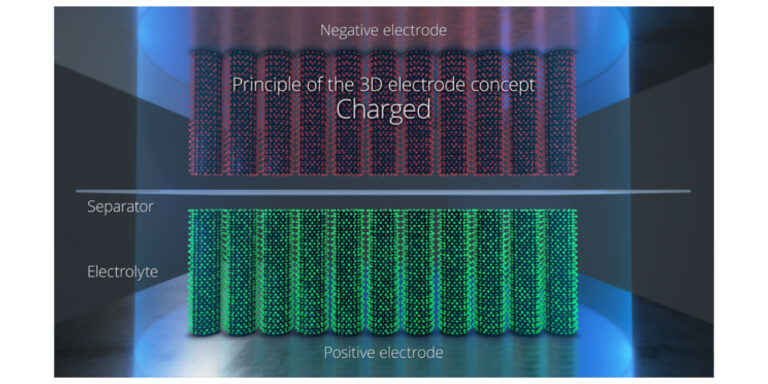
However, the development of a new ultra-fast carbon electrode by French company NAWA, using a vertically aligned carbon nanotube (VACNT) design, is claimed to combine high ionic conductivity – due to a 3D fully accessible nanostructure – with excellent electrical and thermal conductivity, thanks to its arrangement of 100 billion nanotubes/cm2 .

The company states this new 3D electrode geometry can solve the vast majority of performance constraints faced by global battery makers, boosting battery power by a factor of 10, energy storage by up to three and lifecycle by up to five, as well as reducing charging time down to minutes instead of hours.

It notes that the electrode is a universal system, available as a primer for existing electrodes – where the VACNT increases electrical conduction. It is also available as a full 3D electrode (anode or cathode) where the VACNT design serves as a framework on which lithium insertion material can be coated. The company expects the technology to be introduced and in production as early as 2023.

In addition, the company says it is developing a concept called NAWAShell, an integrated structural hybrid battery that incorporates VACNT to give two complementary characteristics: enhanced mechanical strength and electrical energy storage within the core of the composite structure.

Pascal Boulanger, founder, chairman of the board, CTO and COO, commented, “Since the beginning of the battery industry, most performance increases have come from materials but it has reached a plateau today. Combine abundant carbon with nanoscale electrode architecture advances and you have a game-changer.

“NAWA’s Ultra Fast Carbon Electrode brings a step change in electrode design and performance thanks to our vertically aligned carbon nanotube technology. Offering huge increases in power, energy storage and lifecycle, as well as being clean and cost-effective, the potential is enormous.”

Share. Twitter LinkedIn Facebook Email
Previous ArticleSterling PBES introduces next-gen ESS  
Next Article Oceangoing fuel cell project underway

Related Posts

Vessel Build and Maintenance

UECC orders two multi-fuel battery-hybrid PCTCs

March 9, 20263 Mins Read
Battery Technology

AYK Energy to supply battery system for Germany’s next Polarstern research vessel

March 4, 20262 Mins Read
Battery Technology

Kongsberg Maritime to deliver integrated technology package for LS Marine Solution’s advanced cable laying vessel

February 25, 20263 Mins Read
Latest News

Bureau Veritas classes two advanced high-speed all-electric trimarans

March 24, 2026

Princeton University tests Kilo Hydro at Mercury Racing’s Lake X

March 24, 2026

Joint study shows path to green ammonia cost parity

March 19, 2026

Receive breaking stories and features in your inbox each week, for free


Enter your email address:


Supplier Spotlights
  • Adwatec
Getting in Touch
  • Contact Us / Advertise
  • Meet the Editors
  • Media Pack
  • Free Weekly E-Newsletter
Our Social Channels
  • LinkedIn
UKi Media & Events
© 2026 UKi Media & Events a division of UKIP Media & Events Ltd
  • Terms and Conditions
  • Privacy Policy
  • Cookie Policy
  • Notice & Takedown Policy

Type above and press Enter to search. Press Esc to cancel.