


Close Menu
Advanced Maritime Technology International
  • News
    • A-M
      • Battery Technology
      • Environmental
      • Equipment and Services
      • Expo
      • Ferries and Cruises
      • Marine Construction
      • Marine Renewables
    • N-Z
      • Naval Projects
      • Onboard Systems
      • Ports and Harbours
      • Power and Propulsion
      • Shipyards and Shipbuilding
      • Vessel Build and Maintenance
  • Features
  • Online Magazines
  • Opinion
  • Videos
  • Supplier Spotlight
LinkedIn Facebook X (Twitter)
  • Sign-up for Free Weekly E-Newsletter
  • Meet the Editors
  • Contact Us
  • Media Pack
LinkedIn
Subscribe
Advanced Maritime Technology International
  • News
      • Alternative Fuels
      • Autonomous Technology
      • Awards
      • Battery Technology
      • Expo
      • Ferries and Cruises
      • Hydrogen
      • Legislation
      • Motor Technologies
      • New Vessels
      • Onboard Systems
      • Ports and Harbours
      • Power and Propulsion
      • Shipyards and Shipbuilding
      • Vessel Design
  • Features
  • Online Magazines
    1. January 2026
    2. September 2025
    3. April/May 2025
    4. January 2025
    5. September 2024
    6. April 2024
    7. Archive Issues
    8. Subscribe Free!
    Featured
    December 4, 2025

    In this issue – January 2026

    Online Magazines By Web Team
    Recent

    In this issue – January 2026

    December 4, 2025

    In this issue – September 2025

    August 6, 2025

    In this issue – April/May 2025

    May 14, 2025
  • Subscribe
  • Opinion
  • Videos
  • Awards
    • Electric & Hybrid Marine Awards 2025 – Nominations open
    • 2024 Winners
    • 2023 Winners
    • 2022 Winners
    • Previous Winners
  • Supplier Spotlight
  • Expo
LinkedIn Facebook
Subscribe
Advanced Maritime Technology International
Battery Technology

Oceangoing fuel cell project underway

Lawrence ButcherBy Lawrence ButcherOctober 7, 20202 Mins Read
Share
LinkedIn Twitter Facebook Email

A research project has launched in Norway to explore the use of fuel cells on oceangoing vessels, with the hope that emissions can be reduced by 40-100%.

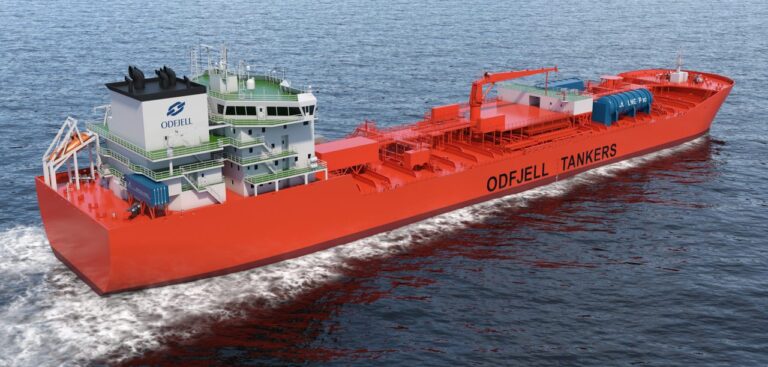
The main partners in the project are Odfjell, Prototech, Wärtsilä and Lundin Energy Norway. Odfjell has leading expertise in global shipping, Prototech in fuel cell technology, Wärtsilä in maritime technology and energy, and Lundin Energy Norway in oil and gas. The system will first be tested at the Sustainable Energy Norwegian Catapult Centre in Stord before installation on board a chemical tanker.

The pilot will investigate the use of different types of fuel, including green ammonia and LNG, the aim being to allow vessels to use different fuel according to availability. “Our tests show a CO2  reduction of as much as 40-45% when using LNG, compared with current solutions. Increased efficiency and reduced fuel consumption also provide significant cost savings, and the ship will be able to sail significantly longer on the same amount of energy. The system will also be ready to operate completely emission-free from the locations where, for instance, ammonia is available for bunkering,” explained Bernt Skeie, CEO of Prototech.

The project aims to develop a technology that can provide emission-free operation over long distances. Battery solutions are currently not suitable for operating ships that sail long distances, the so-called ‘deep-sea’ fleet. This fleet consists of around 50,000 ships globally and thus constitutes a significant share of international shipping. It is impossible to achieve the goal of climate neutrality without finding solutions for this significant segment.

“Ships are to be operated for 20-30 years, and we need flexible solutions that can meet future emission requirements. We do not have time to wait, we have to think about zero emissions already now,” noted Erik Hjortland, technology director at Odfjell SE. “The fuel cell project is one of the paths we are pursuing. We focus on machinery rather than focusing on one single type of fuel. Fuel cell technology gives us flexibility that ensures environmentally efficient operation regardless of fuel changes that may occur in the years ahead.”

So far, the project has been funded with support from Gassnova, NFR, and the participants themselves. The current goal is the construction of a 1.2MW prototype fuel cell that first will be tested at the Sustainable Energy catapult centre. Then it will be mounted and tested onboard one of Odfjell’s newest chemical tankers.

Share. Twitter LinkedIn Facebook Email
Previous ArticleNAWA develops electrode technology that boosts battery performance
Next Article Solar yacht for private operators launches

Related Posts

Power and Propulsion

Princeton University tests Kilo Hydro at Mercury Racing’s Lake X

March 24, 20263 Mins Read
New Vessels

AET and Fleetzero to develop world’s longest-range hybrid-electric vessel

March 16, 20262 Mins Read
Power and Propulsion

Orange Marine selects ABB power, propulsion and automation systems for new cable repair vessels

March 12, 20263 Mins Read
Latest News

Bureau Veritas classes two advanced high-speed all-electric trimarans

March 24, 2026

Princeton University tests Kilo Hydro at Mercury Racing’s Lake X

March 24, 2026

Joint study shows path to green ammonia cost parity

March 19, 2026

Receive breaking stories and features in your inbox each week, for free


Enter your email address:


Supplier Spotlights
  • Arnold Magnetic Technologies
Getting in Touch
  • Contact Us / Advertise
  • Meet the Editors
  • Media Pack
  • Free Weekly E-Newsletter
Our Social Channels
  • LinkedIn
UKi Media & Events
© 2026 UKi Media & Events a division of UKIP Media & Events Ltd
  • Terms and Conditions
  • Privacy Policy
  • Cookie Policy
  • Notice & Takedown Policy

Type above and press Enter to search. Press Esc to cancel.