


Close Menu
Advanced Maritime Technology International
  • News
    • A-M
      • Battery Technology
      • Environmental
      • Equipment and Services
      • Expo
      • Ferries and Cruises
      • Marine Construction
      • Marine Renewables
    • N-Z
      • Naval Projects
      • Onboard Systems
      • Ports and Harbours
      • Power and Propulsion
      • Shipyards and Shipbuilding
      • Vessel Build and Maintenance
  • Features
  • Online Magazines
  • Opinion
  • Videos
  • Supplier Spotlight
LinkedIn Facebook X (Twitter)
  • Sign-up for Free Weekly E-Newsletter
  • Meet the Editors
  • Contact Us
  • Media Pack
LinkedIn
Subscribe
Advanced Maritime Technology International
  • News
      • Alternative Fuels
      • Autonomous Technology
      • Awards
      • Battery Technology
      • Expo
      • Ferries and Cruises
      • Hydrogen
      • Legislation
      • Motor Technologies
      • New Vessels
      • Onboard Systems
      • Ports and Harbours
      • Power and Propulsion
      • Shipyards and Shipbuilding
      • Vessel Design
  • Features
  • Online Magazines
    1. January 2026
    2. September 2025
    3. April/May 2025
    4. January 2025
    5. September 2024
    6. April 2024
    7. Archive Issues
    8. Subscribe Free!
    Featured
    December 4, 2025

    In this issue – January 2026

    Online Magazines By Web Team
    Recent

    In this issue – January 2026

    December 4, 2025

    In this issue – September 2025

    August 6, 2025

    In this issue – April/May 2025

    May 14, 2025
  • Subscribe
  • Opinion
  • Videos
  • Awards
    • Electric & Hybrid Marine Awards 2025 – Nominations open
    • 2024 Winners
    • 2023 Winners
    • 2022 Winners
    • Previous Winners
  • Supplier Spotlight
  • Expo
LinkedIn Facebook
Subscribe
Advanced Maritime Technology International
Battery Technology

NYK, MTI, ABS and WinGD join forces for battery-hybrid optimization research

Callum Brook-JonesBy Callum Brook-JonesDecember 3, 20212 Mins Read
Share
LinkedIn Twitter Facebook Email

NYK, Monohakobi Technology Institute (MTI), the American Bureau of Shipping (ABS) and Winterthur Gas & Diesel (WinGD) have announced the start of a joint research project to optimize ship design by utilizing a battery-hybrid system to aid vessel propulsion while also reducing greenhouse gas emissions.

When sailing in strong waves or winds, the revolutions of a vessel’s main engine might increase significantly to enable the ship to maintain speed – this is known as load fluctuation. The vessel’s shaft generator may also increase the load on the main engine because it is connected to the ship’s propellor shaft. This is used to generate electricity on board the ship as the main engine rotates.

The battery-hybrid system has been designed to reduce the load placed on the main engine by the shaft generator. It supplies electricity from batteries when load on the vessel’s main engine changes. Thus, power for propulsion can be increased and main engine operation becomes more efficient. Furthermore, the system enables a significant reduction in greenhouse gas emissions because a generator is no longer required to supply electricity to onboard equipment.

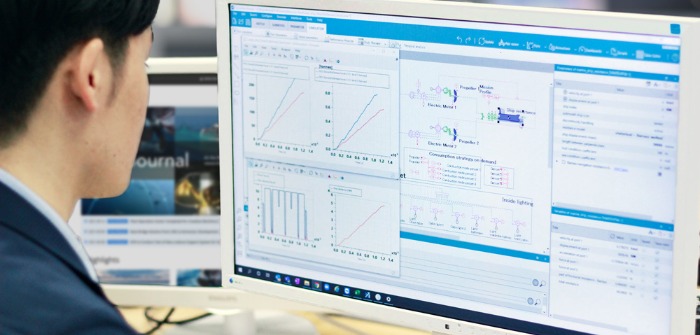
During the joint research project, the companies aim to create an integrated simulation model of ships. This will be done by combining the modeling technologies of each individual partner to ensure that greenhouse gas reduction is maximized when utilizing the battery-hybrid system.

NYK and MTI will combine modeling technologies for actual sea performance to create an integrated model of an entire ship. WinGD’s modeling technology will be used for the engine plants and batteries, and ABS will apply its knowledge to evaluate the effect on greenhouse gas reduction.

Subsequently, a ship will be designed in a digital space and will then undergo navigation simulation using a scenario that assumes meteorological conditions in actual seas. The findings will be used to optimize ship design. The ship model will be verified in accordance with a modeling and simulation framework to be developed by ABS.

In the future, NYK, MTI, ABS, WinGD and shipyards will collate the project’s simulation results with the performance data of real ships carrying out operations at sea to improve simulation accuracy.

NYK and MTI aim to utilize the simulation technology to assist the NYK Group’s shipbuilding plans and optimize the method of operation and control of the battery-hybrid system.

Share. Twitter LinkedIn Facebook Email
Previous ArticleFull-scale test of hydrogen-based propulsion system launched by Kongsberg
Next Article Methanol-fueled towboat to join Maritime Partners fleet

Related Posts

Power and Propulsion

Princeton University tests Kilo Hydro at Mercury Racing’s Lake X

March 24, 20263 Mins Read
Equipment and Services

Alfa Laval expands AR-enabled remote support to boost vessel performance and compliance

March 19, 20263 Mins Read
New Vessels

AET and Fleetzero to develop world’s longest-range hybrid-electric vessel

March 16, 20262 Mins Read
Latest News

Bureau Veritas classes two advanced high-speed all-electric trimarans

March 24, 2026

Princeton University tests Kilo Hydro at Mercury Racing’s Lake X

March 24, 2026

Joint study shows path to green ammonia cost parity

March 19, 2026

Receive breaking stories and features in your inbox each week, for free


Enter your email address:


Supplier Spotlights
  • BlueNav
Getting in Touch
  • Contact Us / Advertise
  • Meet the Editors
  • Media Pack
  • Free Weekly E-Newsletter
Our Social Channels
  • LinkedIn
UKi Media & Events
© 2026 UKi Media & Events a division of UKIP Media & Events Ltd
  • Terms and Conditions
  • Privacy Policy
  • Cookie Policy
  • Notice & Takedown Policy

Type above and press Enter to search. Press Esc to cancel.