


Close Menu
Advanced Maritime Technology International
  • News
    • A-M
      • Battery Technology
      • Environmental
      • Equipment and Services
      • Expo
      • Ferries and Cruises
      • Marine Construction
      • Marine Renewables
    • N-Z
      • Naval Projects
      • Onboard Systems
      • Ports and Harbours
      • Power and Propulsion
      • Shipyards and Shipbuilding
      • Vessel Build and Maintenance
  • Features
  • Online Magazines
  • Opinion
  • Videos
  • Supplier Spotlight
LinkedIn Facebook X (Twitter)
  • Sign-up for Free Weekly E-Newsletter
  • Meet the Editors
  • Contact Us
  • Media Pack
LinkedIn
Subscribe
Advanced Maritime Technology International
  • News
      • Alternative Fuels
      • Autonomous Technology
      • Awards
      • Battery Technology
      • Expo
      • Ferries and Cruises
      • Hydrogen
      • Legislation
      • Motor Technologies
      • New Vessels
      • Onboard Systems
      • Ports and Harbours
      • Power and Propulsion
      • Shipyards and Shipbuilding
      • Vessel Design
  • Features
  • Online Magazines
    1. January 2026
    2. September 2025
    3. April/May 2025
    4. January 2025
    5. September 2024
    6. April 2024
    7. Archive Issues
    8. Subscribe Free!
    Featured
    December 4, 2025

    In this issue – January 2026

    Online Magazines By Web Team
    Recent

    In this issue – January 2026

    December 4, 2025

    In this issue – September 2025

    August 6, 2025

    In this issue – April/May 2025

    May 14, 2025
  • Subscribe
  • Opinion
  • Videos
  • Awards
    • Electric & Hybrid Marine Awards 2025 – Nominations open
    • 2024 Winners
    • 2023 Winners
    • 2022 Winners
    • Previous Winners
  • Supplier Spotlight
  • Expo
LinkedIn Facebook
Subscribe
Advanced Maritime Technology International
Environmental

Scandlines installs Norsepower Rotor Sail technology on hybrid ferry

Matt RossBy Matt RossMay 17, 20223 Mins Read
Share
LinkedIn Twitter Facebook Email

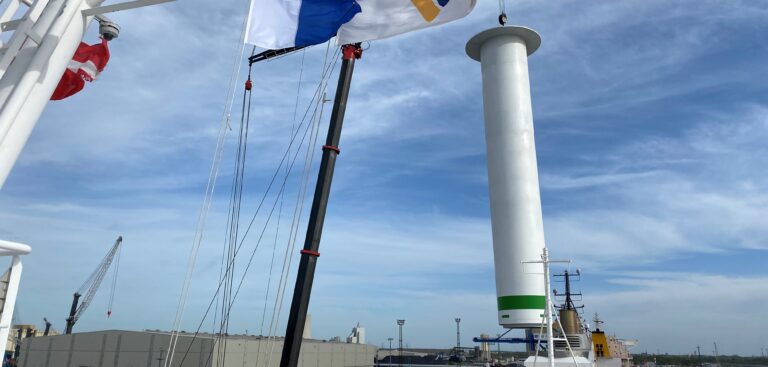
As part of its aim to become emission-free by 2040, Scandlines has set itself higher targets than those laid out in the Paris Agreement. Its latest step is the installation of a Norsepower Rotor Sail on its MV Berlin hybrid ferry.

Since 2013, Scandlines has invested more than US$316m in building and converting conventional ferries into hybrid ferries. In 2020, the ferry operator added environmentally friendly wind propulsion technology to its list of green initiatives by installing a Rotor Sail from Finnish company Norsepower on the hybrid ferry Copenhagen, which operates on the Rostock-Gedser route between Germany and Denmark. The sail has reduced the ferry’s CO2  emissions by an average of 4%. In ideal conditions, with optimal wind conditions, the reduction can be as much as 20%.

The Rotor Sail – a 30m-high rotating cylinder – is a modern version of the Flettner rotor, with technology based on the Magnus effect. When wind meets the spinning Rotor Sail, the airflow accelerates on one side of the sail and decelerates on the opposite side. The change in speed of the airflow results in a pressure difference, which creates a lift force that is perpendicular to the wind flow direction. This enables a reduction in the use of diesel engines and cuts fuel consumption and associated emissions.

On May 16, 2022, Scandlines installed the Norsepower Rotor Sail on MV Berlin in the port of Rostock while the ferry was out of service for a few hours.

“After positive experiences with the Rotor Sail on the hybrid ferry Copenhagen, Scandlines had prepared the sister ferry Berlin for a Rotor Sail as well,” said Michael Guldmann Petersen, the COO of Scandlines. “We are happy to see that the installation was successfully completed and that the ferry went into operation again as planned.”

“Scandlines is taking the international GHG emissions reductions targets extremely seriously and is demonstrating a leading approach to investing in innovation to supersede these,” added Tuomas Riski, the CEO of Norsepower. “Expanding its use of our Rotor Sail technology on its second vessel highlights the viability of wind power and the significance of the emissions savings that can be achieved.”

The Norsepower Rotor Sail is fully automated. The system measures the wind speed and direction and calculates whether use of the Rotor Sail will reduce emissions. If so, the sail starts automatically. However, for specific port areas that are unsuitable for sail use, the Rotor Sail has settings to ensure the technology will not be activated.

Share. Twitter LinkedIn Facebook Email
Previous ArticleCSL’s diesel-electric self-unloading ship enters service
Next Article Brittany Ferries and Titan LNG sign long-term fuel deal for new-build hybrids

Related Posts

Power and Propulsion

Princeton University tests Kilo Hydro at Mercury Racing’s Lake X

March 24, 20263 Mins Read
New Vessels

AET and Fleetzero to develop world’s longest-range hybrid-electric vessel

March 16, 20262 Mins Read
Power and Propulsion

Orange Marine selects ABB power, propulsion and automation systems for new cable repair vessels

March 12, 20263 Mins Read
Latest News

Bureau Veritas classes two advanced high-speed all-electric trimarans

March 24, 2026

Princeton University tests Kilo Hydro at Mercury Racing’s Lake X

March 24, 2026

Joint study shows path to green ammonia cost parity

March 19, 2026

Receive breaking stories and features in your inbox each week, for free


Enter your email address:


Supplier Spotlights
  • Oasis Marine
Getting in Touch
  • Contact Us / Advertise
  • Meet the Editors
  • Media Pack
  • Free Weekly E-Newsletter
Our Social Channels
  • LinkedIn
UKi Media & Events
© 2026 UKi Media & Events a division of UKIP Media & Events Ltd
  • Terms and Conditions
  • Privacy Policy
  • Cookie Policy
  • Notice & Takedown Policy

Type above and press Enter to search. Press Esc to cancel.