

Close Menu
Advanced Maritime Technology International
  • News
    • A-M
      • Battery Technology
      • Environmental
      • Equipment and Services
      • Expo
      • Ferries and Cruises
      • Marine Construction
      • Marine Renewables
    • N-Z
      • Naval Projects
      • Onboard Systems
      • Ports and Harbours
      • Power and Propulsion
      • Shipyards and Shipbuilding
      • Vessel Build and Maintenance
  • Features
  • Online Magazines
  • Opinion
  • Videos
  • Supplier Spotlight
LinkedIn Facebook X (Twitter)
  • Sign-up for Free Weekly E-Newsletter
  • Meet the Editors
  • Contact Us
  • Media Pack
LinkedIn
Subscribe
Advanced Maritime Technology International
  • News
      • Alternative Fuels
      • Autonomous Technology
      • Awards
      • Battery Technology
      • Expo
      • Ferries and Cruises
      • Hydrogen
      • Legislation
      • Motor Technologies
      • New Vessels
      • Onboard Systems
      • Ports and Harbours
      • Power and Propulsion
      • Shipyards and Shipbuilding
      • Vessel Design
  • Features
  • Online Magazines
    1. January 2026
    2. September 2025
    3. April/May 2025
    4. January 2025
    5. September 2024
    6. April 2024
    7. Archive Issues
    8. Subscribe Free!
    Featured
    December 4, 2025

    In this issue – January 2026

    Online Magazines By Web Team
    Recent

    In this issue – January 2026

    December 4, 2025

    In this issue – September 2025

    August 6, 2025

    In this issue – April/May 2025

    May 14, 2025
  • Subscribe
  • Opinion
  • Videos
  • Awards
    • Electric & Hybrid Marine Awards 2025 – Nominations open
    • 2024 Winners
    • 2023 Winners
    • 2022 Winners
    • Previous Winners
  • Supplier Spotlight
  • Expo
LinkedIn Facebook
Subscribe
Advanced Maritime Technology International
Environmental

T&E claims Carnival ship fleet emits 10 times more SOx than all European cars
Dean SlavnichBy Dean SlavnichJune 28, 20193 Mins Read
Share
LinkedIn Twitter Facebook Email

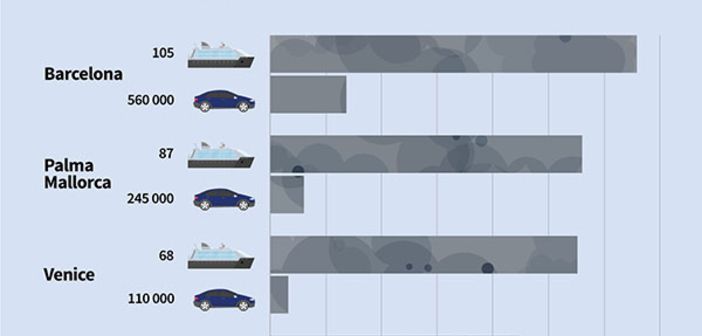
A report released by sustainable transport group Transport & Environment (T&E) claims Carnival Corporation, the world’s largest luxury cruise operator, emitted nearly 10 times more sulfur oxide (SOx) around European coasts than did all 260 million registered European cars in 2017. Royal Caribbean Cruises, the world’s second largest luxury cruise operator, is second, yet four times worse than the European car fleet. According to T&E’s analysis, Spain, Italy, Greece, France and Norway are the European countries most exposed to SOx air pollution from cruise vessels while Barcelona, Palma de Mallorca and Venice are the most impacted European port cities, followed by Rome and Southampton. Faig Abbasov, shipping policy manager at T&E, says these countries are most exposed because they are major tourist destinations and have less stringent marine sulfur fuel standards, which allows cruise ships to burn the most sulfurous fuel all along their coastlines. “Luxury cruise ships are floating cities powered by some of the dirtiest fuel possible,” said Abbasov. “Cities are rightly banning dirty diesel cars but they’re giving a free pass to cruise companies that spew out toxic fumes that do immeasurable harm both to those on board and on nearby shores. This is unacceptable.” The report also states that nitrogen oxide (NOx) emissions from cruise ships in Europe also heavily impact some cities, equivalent to about 15% of the NOx emitted by Europe’s passenger car fleet in a year. T&E claims in Marseille, for example, 57 cruise ships emitted in 2017 almost as much NOx as a quarter of the city’s 340,000 passenger cars. Meanwhile, a handful of cruise ships operating along the coasts of countries such as Norway, Denmark, Greece, Croatia and Malta are reportedly responsible for more NOx than the majority of those countries’ domestic car fleets. T&E recommends Europe implements a zero-emission port standard “as soon as possible, [which] could then be extended to other ship types”. The report also recommends extending emission control areas, currently in place only in the North Sea, Baltic Sea and English Channel, to the rest of the European seas. Furthermore, the report recommends regulating NOx emissions from existing ships which are currently exempt from NOx standards applying in emission control areas. Abbasov concluded: “There are enough mature technologies to clean up cruise ships. Shoreside electricity can help cut in-port emissions, batteries are a solution for shorter distances, and hydrogen technology can power even the biggest cruise ships. The cruise sector is apparently not willing to make the shift voluntarily, so we need governments to step in and mandate zero emission standards.”

Share. Twitter LinkedIn Facebook Email
Previous ArticleElectric & Hybrid Marine World Expo 2019 hailed best show yet!
Next Article Cavotec wins automated mooring order in Finland

Related Posts

Power and Propulsion

Princeton University tests Kilo Hydro at Mercury Racing’s Lake X

March 24, 20263 Mins Read
New Vessels

AET and Fleetzero to develop world’s longest-range hybrid-electric vessel

March 16, 20262 Mins Read
Power and Propulsion

Orange Marine selects ABB power, propulsion and automation systems for new cable repair vessels

March 12, 20263 Mins Read
Latest News

Bureau Veritas classes two advanced high-speed all-electric trimarans

March 24, 2026

Princeton University tests Kilo Hydro at Mercury Racing’s Lake X

March 24, 2026

Joint study shows path to green ammonia cost parity

March 19, 2026

Receive breaking stories and features in your inbox each week, for free


Enter your email address:


Supplier Spotlights
  • Freudenberg e-Power Systems
Getting in Touch
  • Contact Us / Advertise
  • Meet the Editors
  • Media Pack
  • Free Weekly E-Newsletter
Our Social Channels
  • LinkedIn
UKi Media & Events
© 2026 UKi Media & Events a division of UKIP Media & Events Ltd
  • Terms and Conditions
  • Privacy Policy
  • Cookie Policy
  • Notice & Takedown Policy

Type above and press Enter to search. Press Esc to cancel.