


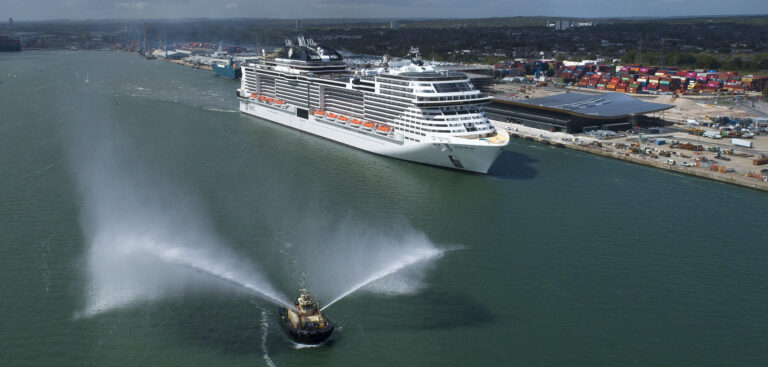
MSC has announced that starting in May 2022 and continuing throughout the 2022 summer season, two of its cruise ships will consistently use shore power: MSC Virtuosa at the Port of Southampton’s new Horizon Cruise Terminal in the UK, and MSC Poesia in Rostock-Warnemünde, Germany (reportedly the largest shore power provider for cruise ships in Europe).
This follows the company’s 2021 commitment to achieving net-zero greenhouse gas emissions by 2050. Having investigated several new technologies to decarbonize company cruise operations, MSC believes the use of shore power to be an effective way to reduce the impact of cruise ships on port environments and surrounding communities when berthed.
“We look forward to using shore power in Southampton and Warnemünde throughout the summer season and we congratulate the port authorities for their forward thinking and innovative commitment,” said Linden Coppell, director of sustainability at MSC Cruises. “We at MSC Cruises are continuously striving to improve our environmental footprint, and shore power allows us to do so by drastically reducing our ships’ emissions while berthed. We need more ports in other key markets in Europe to introduce shore power as quickly as possible, thus joining our efforts toward net-zero emissions by 2050 and greatly reducing our local air emissions.”
Furthermore, Cruise Baltic and MSC Cruises signed a memorandum of understanding (MoU) on April 5, 2022, to jointly contribute to the use of shore power supply within the Baltic Sea area to reduce the environmental impact of the cruise industry. With 32 ports and destinations in the Baltic Sea region, Cruise Baltic has committed to increasing the number of shore power facilities available in the Baltic Sea. MSC Cruises will ensure that its cruise ships – which make regular trips to ports in the region – use shore power where available, beginning no later than January 1, 2024.
By the end of 2022, 11 of MSC Cruises’ 21 ships – including all vessels built since 2017 – will feature shore power capability. As shore power becomes available at more ports, existing MSC vessels will be retrofitted with shore power capability.
“We are committed to supporting authorities in developing shoreside power for our ships while in port,” explained Coppell. “We have a clear and unequivocal position that wherever shore power is available, we will prioritize ships that have that capability. To ensure compatibility with the visiting ships’ systems, we are collaborating closely with port authorities and engineering companies in charge of the infrastructure design. Aspects such as onboard energy demands and ship technical systems need to be considered as part of shoreside planning.”
When directly involved in the building and financing of new terminals, MSC Cruises also ensures that designs meet shore power requirements.
To further contribute to the company’s 2050 net-zero greenhouse gas emissions target, 14 of MSC Cruises’ vessels have been fitted with hybrid exhaust gas cleaning systems to reduce sulfur oxide emissions by 98%. Furthermore, five of its newest ships will have selective catalytic reduction systems to convert nitrogen oxides into harmless nitrogen and water.
MSC Cruises’ first LNG- fueled vessels – the MSC World Europa and MSC Euribia – are under construction, with delivery scheduled for 2022 and 2023 respectively. LNG is seen as a highly effective way of reducing the impact of emissions caused by maritime operations, with sulfur oxides often reduced by 99%, nitrogen oxides by 85% and exhaust particles by 99%. Carbon dioxide emissions can be reduced by up to 25% compared with traditionally used marine fuels.
The MSC World Europa is also claimed to be the first cruise ship to deploy solid oxide fuel cell (SOFC) technology. The fuel cell has been designed to generate electricity 20-30% more efficiently through a non-combustion electrochemical process when utilizing LNG compared with conventional marine combustion-based propulsion and auxiliary engines.
When running on LNG, SOFC technology can reduce carbon equivalent emissions by up to 60% compared with incumbent propulsion sources such as dual-fuel diesel-electric. The system emits virtually no harmful air pollutants such as sulfur oxides, nitrogen oxides and particulate matter.