



University College London (UCL) has published a peer-reviewed study confirming that RAD’s electric propulsion system dramatically reduces underwater noise compared to equivalent internal combustion engines, with reductions of up to 43dB. The research provides clear, scientific evidence that well-engineered electric drives can significantly lower acoustic impact on marine life across a wide range of operating speeds.
UK-based electric marine propulsion company RAD collaborated with UCL’s Department of Mechanical Engineering on the research paper, titled A comparative study of underwater radiated noise from electric and conventional boats. It has been published in the Journal of the Acoustical Society of America.
UCL’s acoustic research team, led by Dr Tom Smith, approached the RAD team to conduct an underwater radiated noise (URN) trial comparing an equivalent powered conventional ICE outboard with the RAD 40 electric outboard. RAD supplied a pair of similar vessels for the initial trial, which took place on the River Hamble, in Hampshire, UK.
UCL observed that the RAD drive produced significantly lower underwater noise levels than anticipated, even noticeably quieter than any previously tested electric propulsion system, particularly across frequency ranges known to be most harmful to marine mammals. These initial findings prompted the commissioning of a second, more controlled trial.

To ensure maximum accuracy and reliability, a lake near Shrewsbury (UK) was selected to provide controlled testing conditions. Two identical boats, one fitted with a RAD 40 and one with an ICE outboard of the same power, were each tested over several days. UCL’s team, supported by RAD engineers, collected an extensive dataset including acoustic measurements from two hydrophones, high-speed underwater video footage and airborne noise measurements across a range of speeds from 4kts to 20kts.
The controlled environment and extended testing period significantly improved the reliability of the results, ultimately providing conclusive evidence in support of the initial River Hamble findings.
“Small vessels are often overlooked when it comes to underwater noise, but they can be really loud,” said Smith. “They also operate in many sensitive environments and so reducing this noise is critical. The results we obtained from the RAD drive were remarkable, particularly at low speed. It was also good to see that the high frequency electrical noise was much smaller than for some other systems, showing that this is a problem that can be fixed. Overall, it’s a really positive result that will hopefully encourage greater uptake of this technology, particularly for operators in environmentally sensitive waters.”
Findings
The paper delivers several significant findings with far-reaching implications for marine conservation and the wider electric marine industry:
- At 4kts, the RAD electric vessel produced a broadband source level 43dB lower than the equivalent combustion engine vessel, a vast reduction that represents an enormous improvement in acoustic conditions for marine life at slow speeds where cavitation is minimal.
- The electric vessel produced lower broadband source levels across the entire speed range tested (4-20kts). Even as cavitation became a factor at higher speeds, the RAD drive maintained a noise advantage over the combustion engine vessel.
- Electric propulsion removes the low-frequency noise associated with internal combustion processes and exhaust gas expulsion through the propeller hub, a category of noise particularly damaging to low-frequency hearing specialists such as baleen whales.
- The high-frequency tonal noise produced by the RAD motor and power electronics was measurable but found to be lower than levels reported for other electric propulsion systems in previous studies, highlighting the importance of motor and power electronics design, and that not all electric drives are acoustically equal.
- The research notes that electric propulsion offers particular advantages for species sensitive to low-frequency noise. For species with stronger high-frequency hearing capabilities, such as odontocete cetaceans and pinnipeds, managing cavitation noise at higher speeds remains an important consideration regardless of propulsion type.
Building on the momentum of the controlled lake trials, the collaboration extended its reach to Namibia, where RAD-powered vessels were already in commercial operation on the Chobe River for Pangolin Photo Safaris, a leading photography safari company. The fleet included their houseboat, The Pangolin Voyager, fitted with four RAD 40 drives and an electric custom-built photo boat powered by a single RAD 40.
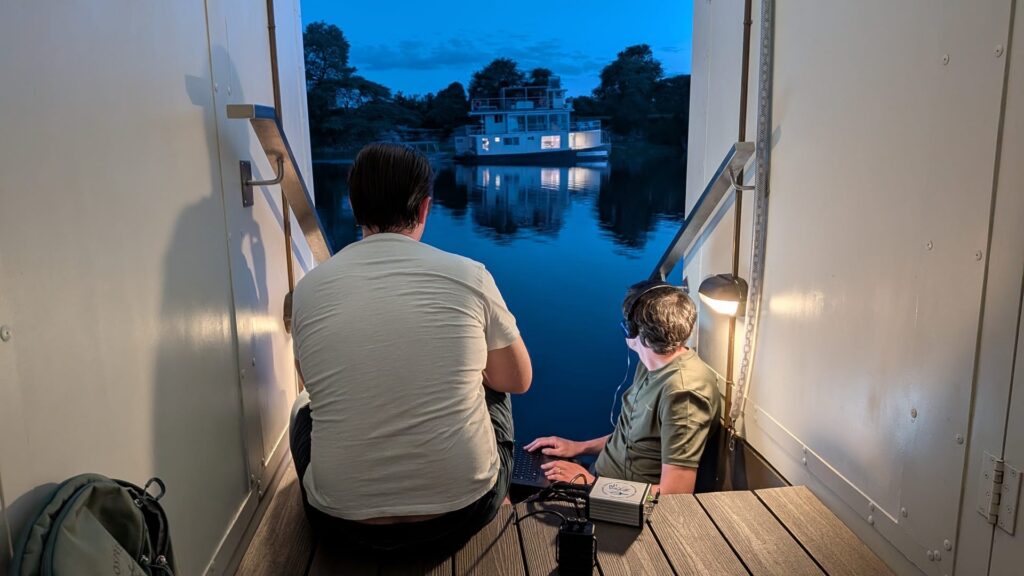
UCL used this opportunity to study the real-world effects of underwater noise on local wildlife, including hippopotamuses, which are believed by some researchers to use a form of echolocation (though this remains unproven). Direct comparisons were made between the RAD-powered hotel boat and hotel boats from other operators, again demonstrating a significant reduction in underwater noise from the RAD propulsion systems.
“We have always believed that how an electric drive is engineered matters enormously, not just for performance, but for its true environmental benefit,” said RAD chief technology officer Peter Byford. “This research validates that belief with rigorous science. We are incredibly proud to support UCL with the study and what it means for the future of quieter, more sustainable marine operations worldwide.”
The research team also wished to acknowledge the significant contribution of Dr Charlotte Findlay at Heriot Watt University, whose expertise on the impacts of underwater noise on marine life has been central to understanding the real-world conservation benefits of these findings.
The study provides valuable insights for policymakers, conservationists and the marine industry, reinforcing the importance of quieter technologies in preserving aquatic ecosystems.
The full research paper can be found here.
Related news, First Elevation series CSOV launched in Europe