


Close Menu
Advanced Maritime Technology International
  • News
    • A-M
      • Battery Technology
      • Environmental
      • Equipment and Services
      • Expo
      • Ferries and Cruises
      • Marine Construction
      • Marine Renewables
    • N-Z
      • Naval Projects
      • Onboard Systems
      • Ports and Harbours
      • Power and Propulsion
      • Shipyards and Shipbuilding
      • Vessel Build and Maintenance
  • Features
  • Online Magazines
  • Opinion
  • Videos
  • Supplier Spotlight
LinkedIn Facebook X (Twitter)
  • Sign-up for Free Weekly E-Newsletter
  • Meet the Editors
  • Contact Us
  • Media Pack
LinkedIn
Subscribe
Advanced Maritime Technology International
  • News
      • Alternative Fuels
      • Autonomous Technology
      • Awards
      • Battery Technology
      • Expo
      • Ferries and Cruises
      • Hydrogen
      • Legislation
      • Motor Technologies
      • New Vessels
      • Onboard Systems
      • Ports and Harbours
      • Power and Propulsion
      • Shipyards and Shipbuilding
      • Vessel Design
  • Features
  • Online Magazines
    1. January 2026
    2. September 2025
    3. April/May 2025
    4. January 2025
    5. September 2024
    6. April 2024
    7. Archive Issues
    8. Subscribe Free!
    Featured
    December 4, 2025

    In this issue – January 2026

    Online Magazines By Web Team
    Recent

    In this issue – January 2026

    December 4, 2025

    In this issue – September 2025

    August 6, 2025

    In this issue – April/May 2025

    May 14, 2025
  • Subscribe
  • Opinion
  • Videos
  • Awards
    • Electric & Hybrid Marine Awards 2025 – Nominations open
    • 2024 Winners
    • 2023 Winners
    • 2022 Winners
    • Previous Winners
  • Supplier Spotlight
  • Expo
LinkedIn Facebook
Subscribe
Advanced Maritime Technology International
Battery Technology

Solé Advance develops hydrogen fuel cell for marine propulsion and onboard power generation

Alex PackBy Alex PackNovember 13, 20252 Mins Read
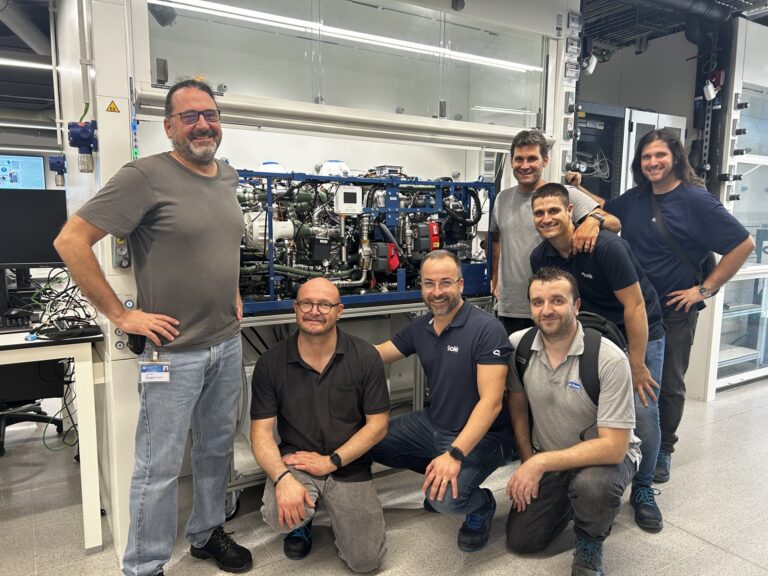
Solé Advance staff pose in front of fuel cell technology in a small laboratory environment
In the image, on the left, Attila Husar, Director of the H2 UPC Lab, together with Solé Advance’s engineering team, led by Víctor Miravet.
Share
LinkedIn Twitter Facebook Email

Solé Advance has announced the development of a proton exchange membrane (PEM) hydrogen fuel cell for integration into marine electric/hybrid propulsion solutions and onboard power generation.

The announcement follows progress the Barcelona-based marine engine manufacturer has made on HVO compatibility and new efficiency focused ranges. It forms part of the company’s R&D program, with applications in other industrial uses beyond marine also being considered.

The program is being developed at Solé with technical collaboration from Applus+ Idiada and the H2Lab at the Universitat Politècnica de Catalunya – BarcelonaTech (UPC).

The fuel-cell stack is supplied by EKPO, freeing Solé and its collaborators to focus on the design of the balance of plant (BOP) – thermal and air management, humidification and purging, power supply, instrumentation and protections – as well as on marine integration (control, cooling, safety and durability in saline environments).

The work has culminated in the assembly of a first integrated prototype, already validated at UPC’s laboratory during its initial test campaign. The project has a target output of 76kW for the PME fuel cell.

One key advantage of the prototype is its compactness, which is said to ease installation in the confined spaces typical of engine rooms without compromising service access.

Marieli Solé, CEO of Solé Advance, said, “This program is a natural step in our evolution toward next-generation onboard power systems and technological transition: integrating a 76kW hydrogen fuel cell with safety, efficiency and maintenance criteria tailored to real operation on board, in both leisure and workboats.”

Víctor Miravet, director of engineering and manufacturing at Solé, added, “Initial tests at UPC’s laboratory have been encouraging. Our next step is to transfer those results to real operating conditions on a vessel, ensuring optimal cooling, consolidating a robust energy solution within an interconnected onboard energy ecosystem, developing control strategies for the most efficient power management possible, and paying special attention to corrosion resistance.”

In related news, Rolls-Royce successfully tests first pure methanol marine engine

Share. Twitter LinkedIn Facebook Email
Previous ArticleAnemoi installs five rotor sails on 400,000 DWT ore carrier
Next Article Wattlab installs first full-scale solar array on a seagoing vessel

Related Posts

Power and Propulsion

Princeton University tests Kilo Hydro at Mercury Racing’s Lake X

March 24, 20263 Mins Read
New Vessels

AET and Fleetzero to develop world’s longest-range hybrid-electric vessel

March 16, 20262 Mins Read
Power and Propulsion

Orange Marine selects ABB power, propulsion and automation systems for new cable repair vessels

March 12, 20263 Mins Read
Latest News

Bureau Veritas classes two advanced high-speed all-electric trimarans

March 24, 2026

Princeton University tests Kilo Hydro at Mercury Racing’s Lake X

March 24, 2026

Joint study shows path to green ammonia cost parity

March 19, 2026

Receive breaking stories and features in your inbox each week, for free


Enter your email address:


Supplier Spotlights
  • Twin Disc
Getting in Touch
  • Contact Us / Advertise
  • Meet the Editors
  • Media Pack
  • Free Weekly E-Newsletter
Our Social Channels
  • LinkedIn
UKi Media & Events
© 2026 UKi Media & Events a division of UKIP Media & Events Ltd
  • Terms and Conditions
  • Privacy Policy
  • Cookie Policy
  • Notice & Takedown Policy

Type above and press Enter to search. Press Esc to cancel.