


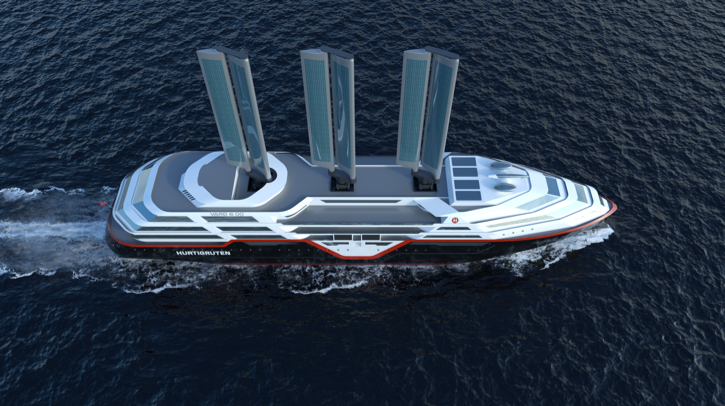
Hurtigruten has released its updated plans for its Sea Zero project, the zero-emission ship scheduled to debut in 2030 which is in its research and development phase. The company’s calculations show that the ship will use about 40-50% less energy than today’s ships, which makes it possible to operate primarily on batteries and sails as the main energy source.
Hurtigruten initially announced its Sea Zero project in October 2022, and then unveiled its first set of renderings in summer 2023. As the research and development phase has continued since, the second version of renderings has seen the plans advance even more. It was developed in the Norwegian city of Ålesund by Vard, one of Hurtigruten’s partners in the project, and integrates several solutions created in collaboration with partners from the Norwegian maritime industry.
“The cruising industry is a significant polluter, and it is crucial that we now take major steps to reduce emissions. Our goal is to have an emission-free ship in operation by around 2030. We are still in the research and development phase, but we have made significant progress,” said Hedda Felin, CEO of Hurtigruten.
Energy-efficient sails
The sails can be raised and lowered as needed. Preliminary estimates indicate that the sails could reduce energy consumption by around 10% over time, with solar panels contributing another 2-3% in energy savings. The type of sail being investigated is called OceanWings. These French-developed sails are already in use on the cargo ship Canopée.
“We still see significant energy savings from having retractable sails with solar panels, but this requires thorough studies, including model tests to be conducted in the coming months. We have also changed the sail type to a more mature design already in use on cargo ships,” said Gerry Larsson-Fedde, chief operating officer at Hurtigruten. “As with all development projects, there will be adjustments to both the design and specifications along the way.”
Propulsion technology
The ship is planned with contra-rotating propellers as the main propulsion, and the batteries will have a capacity of around 60MW/h. Two retractable thrusters at the stern will ensure optimal maneuvering during port operations and provide increased safety through redundancy.
“The central part of the project is to reduce energy consumption. The goal is to use significantly less energy than today’s ships, which requires innovative solutions,” said Larsson-Fedde.
Another measure incorporated in the plans is air lubrication of the hull, where air bubbles are pumped beneath the hull to reduce drag. This can provide energy savings of 5-10%. Combined with modern hull design, advanced anti-fouling coatings and regular hull cleaning, water resistance can be significantly reduced. Preliminary results also show that better ventilation and insulation systems, as well as advanced energy management, can lead to significant energy savings.
The plans also include “smart cabins” that will enable guests to control their own energy use. Guests would be able to control heating and ventilation through an app and a screen in the cabin, while also seeing how much energy is being used. This will increase guests’ awareness of sustainability.
“We are already testing advanced sensors in these cabins, and in the near future, we will conduct full-scale tests with guests on board,” Larsson-Fedde said.
For more of the top insights into the future of zero-emission cruise ship design, read Electric and Hybrid Marine Technology’s exclusive feature “How are large-scale cruise vessels making the switch to electric power?”, here.