


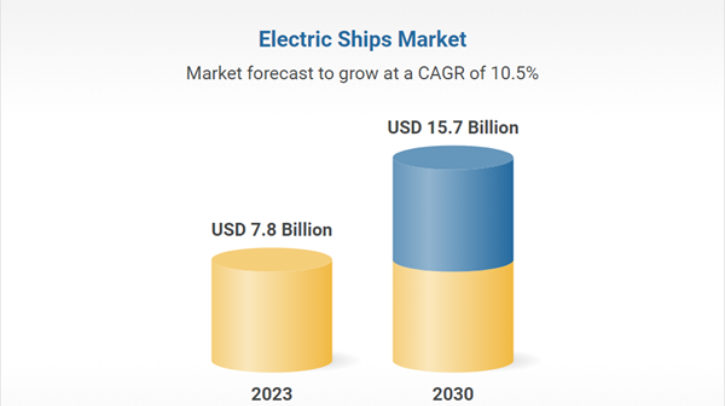
According to ResearchAndMarkets.com’s Electric Ships – Global Strategic Business Report, the global market for electric ships was estimated at US$7.8bn in 2023 and is projected to reach US$15.7bn by 2030, growing at a CAGR of 10.5% from 2023 to 2030.
Additionally, the hybrid ships segment is expected to reach US$12.7bn by 2030 with a CAGR of 10.4%. The fully electric ships segment is also set to grow at 10.8% CAGR over the analysis period.
The report also highlights that Norway has been a pioneer in the marine electrification shift, with the introduction of electric ferries that operate on renewable energy sources, while other countries, including China, Japan and the USA, are following suit with their initiatives. In particular, the US market is estimated at US$2.1bn in 2023, and China is forecasted to grow at a 10.0% CAGR to reach US$2.4bn by 2030.
Driving growth
The growth in the electric ships market is reportedly driven by several factors, including stringent environmental regulations, the demand for sustainable transportation and advances in energy storage and propulsion technologies. Increasingly strict emissions standards, such as the International Maritime Organization’s (IMO) mandate to reduce greenhouse gas emissions by 50% by 2050, are compelling shipbuilders and operators to seek cleaner alternatives to diesel engines.
Countries are enforcing regional emissions standards, putting further pressure on the maritime industry to adopt low- and zero-emission solutions. Consumer demand for environmentally friendly options is also influencing the market, as passengers and shipping clients prioritize companies with sustainable practices, especially in environmentally sensitive regions and popular tourist destinations.
Technological advances in battery and fuel cell technologies were found to be another major growth driver, enabling electric ships to operate with greater efficiency and range. As battery costs decrease and charging infrastructure expands, electric ships are becoming more economically viable. Government subsidies and incentives are also playing a significant role, especially in Europe and Asia, where electric ship development is actively supported by financial backing for manufacturers and fleet operators.
Additionally, the development of autonomous electric ships is sparking interest in future-ready maritime solutions, with automation technologies further increasing the efficiency of electric ships. Together, these factors are accelerating the adoption of electric ships across various maritime sectors, positioning the electric ships market as a critical contributor to the global shift toward sustainable, low-emission transportation.
Maritime applications
In the passenger ferry sector, Norway has implemented the Ampere fully electric ferry. Coastal cities with high tourism levels, such as those in the Mediterranean and Caribbean, are increasingly adopting electric vessels to reduce environmental impacts and cater to eco-conscious tourists.
Electric propulsion is also being adopted for inland waterway transportation, where vessels operate over shorter distances and can benefit from charging infrastructure at regular intervals. Cargo shipping, traditionally one of the largest polluters, is beginning to explore hybrid and fully electric solutions for short-haul and coastal routes. Some companies are testing battery-powered cargo ships, especially for routes within the EU, where stringent emissions regulations are driving rapid innovation.
Offshore support vessels, which require high maneuverability and operate in environmentally sensitive areas, are another promising application for electric propulsion. These vessels often operate close to marine reserves, where reducing pollution and underwater noise is critical. As electric ships prove their operational and environmental benefits, their adoption across various maritime sectors is expected to accelerate, setting new standards for clean and efficient shipping solutions.
For more of the top insights into the electric ship industry, read E&H Marine’s exclusive feature How are the latest developments in propeller design optimizing electric and hybrid vessels?, here.