


Close Menu
Advanced Maritime Technology International
  • News
    • A-M
      • Battery Technology
      • Environmental
      • Equipment and Services
      • Expo
      • Ferries and Cruises
      • Marine Construction
      • Marine Renewables
    • N-Z
      • Naval Projects
      • Onboard Systems
      • Ports and Harbours
      • Power and Propulsion
      • Shipyards and Shipbuilding
      • Vessel Build and Maintenance
  • Features
  • Online Magazines
  • Opinion
  • Videos
  • Supplier Spotlight
LinkedIn Facebook X (Twitter)
  • Sign-up for Free Weekly E-Newsletter
  • Meet the Editors
  • Contact Us
  • Media Pack
LinkedIn
Subscribe
Advanced Maritime Technology International
  • News
      • Alternative Fuels
      • Autonomous Technology
      • Awards
      • Battery Technology
      • Expo
      • Ferries and Cruises
      • Hydrogen
      • Legislation
      • Motor Technologies
      • New Vessels
      • Onboard Systems
      • Ports and Harbours
      • Power and Propulsion
      • Shipyards and Shipbuilding
      • Vessel Design
  • Features
  • Online Magazines
    1. January 2026
    2. September 2025
    3. April/May 2025
    4. January 2025
    5. September 2024
    6. April 2024
    7. Archive Issues
    8. Subscribe Free!
    Featured
    December 4, 2025

    In this issue – January 2026

    Online Magazines By Web Team
    Recent

    In this issue – January 2026

    December 4, 2025

    In this issue – September 2025

    August 6, 2025

    In this issue – April/May 2025

    May 14, 2025
  • Subscribe
  • Opinion
  • Videos
  • Awards
    • Electric & Hybrid Marine Awards 2025 – Nominations open
    • 2024 Winners
    • 2023 Winners
    • 2022 Winners
    • Previous Winners
  • Supplier Spotlight
  • Expo
LinkedIn Facebook
Subscribe
Advanced Maritime Technology International
Environmental

Ulstein unveils second hydrogen-fueled wind turbine installation vessel

Lawrence ButcherBy Lawrence ButcherOctober 14, 20202 Mins Read
Share
LinkedIn Twitter Facebook Email

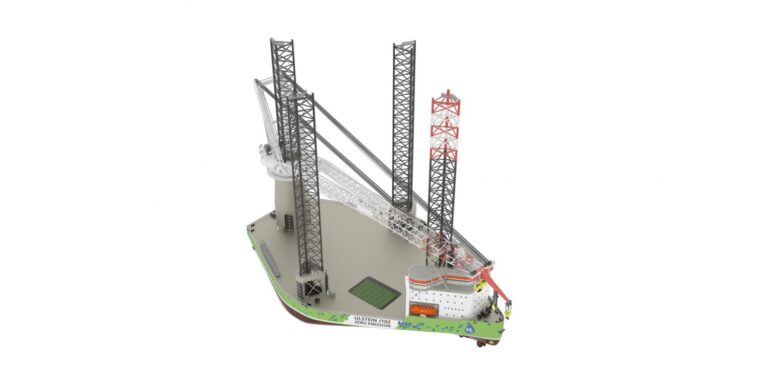
Ulstein, a marine enterprise company undertaking both ship design and building services as well as shipping activity, has revealed details of its second hydrogen hybrid wind turbine installation vessel.

According to the company, the J102 zero-emission wind turbine installation vessel (WTIV) will be able to operate for 75% of the time in zero-emission mode. Notably, the company claims that by using readily available technology, the additional cost (over other propulsion systems) is limited to less than 5% of the total CAPEX.

Ulstein notes that most new jack-up designs utilize a battery hybrid system in addition to diesel gensets, with a future option for upgrading to a hydrogen-powered fuel cell system. The downside of a high-power battery energy storage system (BESS) is its heavy weight and cost. That is not ideal for a WTIV design, where weight savings are essential for minimizing elevated weight and optimizing the variable deck load.

Rather than opt for technology to be matured to perfection and make a design that is prepared for future hydrogen-powered fuel cells, Ulstein says it has taken the pragmatic yet realistic approach. “We have carefully analyzed the operational cycle of WTIVs and looked at the power demand in the various modes of operations”, explained Ko Stroo, product manager at Ulstein. “This analysis showed that around 75% of its time, a WTIV is in jacked-up position performing crane operations. Using a combination of a hydrogen fuel cell system and a relatively small battery energy storage system (BESS) is then sufficient to meet the overall power demand on board and crane peak loads.”

“The same design philosophy as on our first hydrogen powered SX190 design resulted in a much more attractive business case when applied to a turbine installation vessel,” added Edwin van Leeuwen, managing director of Ulstein’s Rotterdam design office.

The company says that its hydrogen hybrid system has been developed in such a way that future developments in hydrogen technology can easily be fitted into the vessel without major modifications.

“The limited availability of hydrogen bunker infrastructure in ports is often seen as a major hurdle. With our modular storage layout, we want to break the chicken and egg dilemma,” continued Stroo. “It [the design] creates flexibility to operate the vessel worldwide, even when bunker infrastructure is not yet present.”

Share. Twitter LinkedIn Facebook Email
Previous ArticleEmission-free tours of Niagara Falls
Next Article Proton Motor receives fuel cell order

Related Posts

Power and Propulsion

Princeton University tests Kilo Hydro at Mercury Racing’s Lake X

March 24, 20263 Mins Read
New Vessels

First fully electric harbor tug in Southeast Asia delivered

March 19, 20262 Mins Read
Equipment and Services

Alfa Laval expands AR-enabled remote support to boost vessel performance and compliance

March 19, 20263 Mins Read
Latest News

Bureau Veritas classes two advanced high-speed all-electric trimarans

March 24, 2026

Princeton University tests Kilo Hydro at Mercury Racing’s Lake X

March 24, 2026

Joint study shows path to green ammonia cost parity

March 19, 2026

Receive breaking stories and features in your inbox each week, for free


Enter your email address:


Supplier Spotlights
  • Genevos logo
    Genevos
Getting in Touch
  • Contact Us / Advertise
  • Meet the Editors
  • Media Pack
  • Free Weekly E-Newsletter
Our Social Channels
  • LinkedIn
UKi Media & Events
© 2026 UKi Media & Events a division of UKIP Media & Events Ltd
  • Terms and Conditions
  • Privacy Policy
  • Cookie Policy
  • Notice & Takedown Policy

Type above and press Enter to search. Press Esc to cancel.