


Close Menu
Advanced Maritime Technology International
  • News
    • A-M
      • Battery Technology
      • Environmental
      • Equipment and Services
      • Expo
      • Ferries and Cruises
      • Marine Construction
      • Marine Renewables
    • N-Z
      • Naval Projects
      • Onboard Systems
      • Ports and Harbours
      • Power and Propulsion
      • Shipyards and Shipbuilding
      • Vessel Build and Maintenance
  • Features
  • Online Magazines
  • Opinion
  • Videos
  • Supplier Spotlight
LinkedIn Facebook X (Twitter)
  • Sign-up for Free Weekly E-Newsletter
  • Meet the Editors
  • Contact Us
  • Media Pack
LinkedIn
Subscribe
Advanced Maritime Technology International
  • News
      • Alternative Fuels
      • Autonomous Technology
      • Awards
      • Battery Technology
      • Expo
      • Ferries and Cruises
      • Hydrogen
      • Legislation
      • Motor Technologies
      • New Vessels
      • Onboard Systems
      • Ports and Harbours
      • Power and Propulsion
      • Shipyards and Shipbuilding
      • Vessel Design
  • Features
  • Online Magazines
    1. January 2026
    2. September 2025
    3. April/May 2025
    4. January 2025
    5. September 2024
    6. April 2024
    7. Archive Issues
    8. Subscribe Free!
    Featured
    December 4, 2025

    In this issue – January 2026

    Online Magazines By Web Team
    Recent

    In this issue – January 2026

    December 4, 2025

    In this issue – September 2025

    August 6, 2025

    In this issue – April/May 2025

    May 14, 2025
  • Subscribe
  • Opinion
  • Videos
  • Awards
    • Electric & Hybrid Marine Awards 2025 – Nominations open
    • 2024 Winners
    • 2023 Winners
    • 2022 Winners
    • Previous Winners
  • Supplier Spotlight
  • Expo
LinkedIn Facebook
Subscribe
Advanced Maritime Technology International
Power and Propulsion

Advances in atomic power for shipping

Lawrence ButcherBy Lawrence ButcherNovember 4, 20202 Mins Read
Share
LinkedIn Twitter Facebook Email

A consortium consisting of UK-based Core Power, alongside US energy supplier Southern Company, nuclear energy specialists TerraPower and Orano USA, is looking to develop Molten Salt Reactor (MSR) atomic technology in the USA, with the potential for use in commercial shipping.

The team says it has submitted its application to the US Department of Energy to take part in cost-share risk reduction awards under the Advanced Reactor Demonstration Program, in order to build a prototype MSR as a proof-of-concept for a medium-scale commercial-grade reactor.

The consortium notes that, over the coming decades, as many as 60,000 ships must transition from combustion of fossil fuels to zero-emission propulsion. The UN’s maritime agency IMO has mandated with unanimous approval from 197 countries that shipping must reduce emissions by 50% of the 2008 total, before 2050. This means an actual emission reduction of almost 90%, by 2050. The MSR technology being developed by the consortium could achieve that goal, by powering production of green sustainable fuels for smaller ships and providing onboard electric power for large ships.

Core Power explains that Marine MSRs (m-MSR) use a fluid fuel in the form of very hot fluoride or chloride salt infused with a ‘hot’ fissile material instead of solid fuel rods which are used in conventional pressurized water reactors (PWRs). They have no moving parts, operate at very high temperatures under only ambient pressure, and can be made small enough to provide ‘micro-grid-scale’ electric power for energy-hungry assets, like large ships. For this reason, Core Power claims they can be mass-manufactured to bring the cost of energy in line with existing fuels.

According to the company, there are several molten salt reactor designs being proposed, which can be divided into two categories: fast-spectrum reactors, which are best operated with chloride salts, and thermal-spectrum reactors, which are best operated with fluoride salts.

Fluoride reactors don’t necessarily have to be thermal spectrum, but usually they are, using graphite as a moderator to slow down the high-energy neutrons of fission. Chloride reactors don’t have to be fast spectrum, but they are usually intended to be. Hence, fluoride in general implies thermal spectrum and chloride in general implies fast spectrum.

The company notes that fluoride reactors would be ideally suited to run a thorium fuel cycle (Th232/U233), while chloride reactors are best run using the uranium fuel cycle (U235-8).

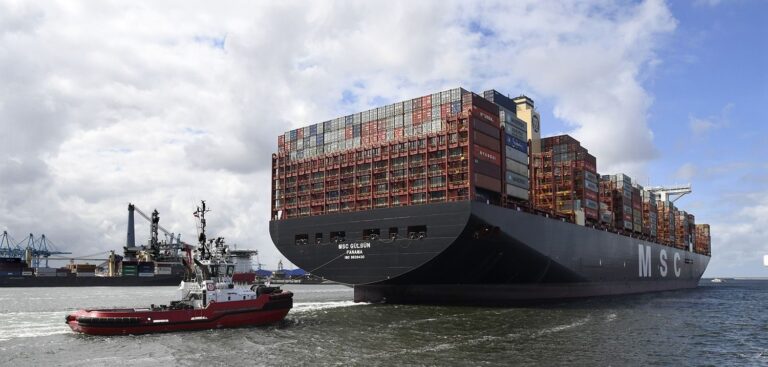
Pic: Ries van Wendel de Joode/Port of Rotterdam

Share. Twitter LinkedIn Facebook Email
Previous ArticleExclusive Interview: Marco Cassinelli, CTO, Sealence
Next Article Cavotec launches automated mooring system

Related Posts

Power and Propulsion

Princeton University tests Kilo Hydro at Mercury Racing’s Lake X

March 24, 20263 Mins Read
New Vessels

AET and Fleetzero to develop world’s longest-range hybrid-electric vessel

March 16, 20262 Mins Read
Power and Propulsion

Orange Marine selects ABB power, propulsion and automation systems for new cable repair vessels

March 12, 20263 Mins Read
Latest News

Bureau Veritas classes two advanced high-speed all-electric trimarans

March 24, 2026

Princeton University tests Kilo Hydro at Mercury Racing’s Lake X

March 24, 2026

Joint study shows path to green ammonia cost parity

March 19, 2026

Receive breaking stories and features in your inbox each week, for free


Enter your email address:


Supplier Spotlights
  • Bosch Engineering GmbH
Getting in Touch
  • Contact Us / Advertise
  • Meet the Editors
  • Media Pack
  • Free Weekly E-Newsletter
Our Social Channels
  • LinkedIn
UKi Media & Events
© 2026 UKi Media & Events a division of UKIP Media & Events Ltd
  • Terms and Conditions
  • Privacy Policy
  • Cookie Policy
  • Notice & Takedown Policy

Type above and press Enter to search. Press Esc to cancel.