


Close Menu
Advanced Maritime Technology International
  • News
    • A-M
      • Battery Technology
      • Environmental
      • Equipment and Services
      • Expo
      • Ferries and Cruises
      • Marine Construction
      • Marine Renewables
    • N-Z
      • Naval Projects
      • Onboard Systems
      • Ports and Harbours
      • Power and Propulsion
      • Shipyards and Shipbuilding
      • Vessel Build and Maintenance
  • Features
  • Online Magazines
  • Opinion
  • Videos
  • Supplier Spotlight
LinkedIn Facebook X (Twitter)
  • Sign-up for Free Weekly E-Newsletter
  • Meet the Editors
  • Contact Us
  • Media Pack
LinkedIn
Subscribe
Advanced Maritime Technology International
  • News
      • Alternative Fuels
      • Autonomous Technology
      • Awards
      • Battery Technology
      • Expo
      • Ferries and Cruises
      • Hydrogen
      • Legislation
      • Motor Technologies
      • New Vessels
      • Onboard Systems
      • Ports and Harbours
      • Power and Propulsion
      • Shipyards and Shipbuilding
      • Vessel Design
  • Features
  • Online Magazines
    1. January 2026
    2. September 2025
    3. April/May 2025
    4. January 2025
    5. September 2024
    6. April 2024
    7. Archive Issues
    8. Subscribe Free!
    Featured
    December 4, 2025

    In this issue – January 2026

    Online Magazines By Web Team
    Recent

    In this issue – January 2026

    December 4, 2025

    In this issue – September 2025

    August 6, 2025

    In this issue – April/May 2025

    May 14, 2025
  • Subscribe
  • Opinion
  • Videos
  • Awards
    • Electric & Hybrid Marine Awards 2025 – Nominations open
    • 2024 Winners
    • 2023 Winners
    • 2022 Winners
    • Previous Winners
  • Supplier Spotlight
  • Expo
LinkedIn Facebook
Subscribe
Advanced Maritime Technology International
Power and Propulsion

Energy-efficient rudder system to be trialled on commercial vessel

Lawrence ButcherBy Lawrence ButcherMay 10, 20213 Mins Read
Share
LinkedIn Twitter Facebook Email

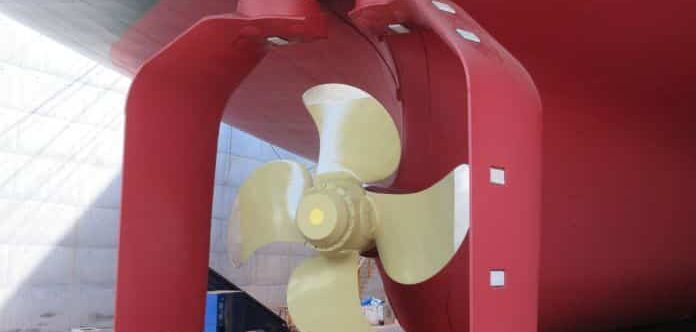
A greener, more efficient rudder system designed at the University of Strathclyde is to be demonstrated as part of a €6m EU-funded research project. The GATERS project, led by the University of Strathclyde under the Horizon 2020 Fund, will see the ‘gate rudder’ – a novel propulsion and steering system – retrofitted to a commercial vessel as part of a trial.

Unlike a traditional rudder, which sits behind a ship’s propellers to steer the vessel, the U-shaped gate rudder – essentially two separate rudders – sits astride the propeller, which, as a result, acts like a nozzle around the propeller and generates additional thrust. Both rudders can be independently controlled to provide finer steering control as well as helping vessels move sideways – called crabbing – when docking, for example.

In early trials, the gate rudder is claimed to have shown fuel-saving potential of 15% in calm waters, and as much as 30% in rough seas with improved maneuverability. It is also quieter than a traditional rudder system, reduces hull wake and can help to protect the propeller from damage – particularly beneficial in sensitive environments such as the Arctic.

Professor Mehmet Atlar, who is the project coordinator from Department of Naval Architecture, Ocean & Marine Engineering (NAOME) at Strathclyde, explained, “GATERS demonstrates significantly reduced emissions from ships particularly within coastal and port areas, challenging and even exceeding the current and future legislative requirements of the International Maritime Organization and local regulations for emissions.

“As a propulsor-based solution, the gate rudder offers a significant amount of power-saving that cannot be achieved by any other single energy-saving device currently available in the market.

“An important advantage of the gate rudder system is highly effective maneuverability within coastal and port areas as well as navigating more efficiently in waves during oceangoing operations. In addition, the gate rudder system is simple, generic and flexible, and can be installed on new-build ships or retrofitted to existing ships, as well as integrated easily with other fuel-saving and emission-reduction technologies. Based on these features, the gate rudder design presents a great prospect of replacing conventional design.”

The project’s researchers will use data gathered from the sea trials to demonstrate for the first time whether the system could be applied to an existing 90m coastal cargo ship as a retrofit and to explore its applications for other oceangoing vessel types and sizes – hence, ultimately becoming the next-generation propulsion and steering system for waterborne transport. The concept of the gate rudder has also been licensed to the world’s largest propulsion manufacturer, Wärtsilä.

Share. Twitter LinkedIn Facebook Email
Previous ArticleConsortium of Japanese manufacturers to develop hydrogen-fueled marine engines
Next Article Latest electric RIB from RS uses rim drive motors

Related Posts

Power and Propulsion

Princeton University tests Kilo Hydro at Mercury Racing’s Lake X

March 24, 20263 Mins Read
New Vessels

AET and Fleetzero to develop world’s longest-range hybrid-electric vessel

March 16, 20262 Mins Read
Power and Propulsion

Orange Marine selects ABB power, propulsion and automation systems for new cable repair vessels

March 12, 20263 Mins Read
Latest News

Bureau Veritas classes two advanced high-speed all-electric trimarans

March 24, 2026

Princeton University tests Kilo Hydro at Mercury Racing’s Lake X

March 24, 2026

Joint study shows path to green ammonia cost parity

March 19, 2026

Receive breaking stories and features in your inbox each week, for free


Enter your email address:


Supplier Spotlights
  • Bosch Engineering GmbH
Getting in Touch
  • Contact Us / Advertise
  • Meet the Editors
  • Media Pack
  • Free Weekly E-Newsletter
Our Social Channels
  • LinkedIn
UKi Media & Events
© 2026 UKi Media & Events a division of UKIP Media & Events Ltd
  • Terms and Conditions
  • Privacy Policy
  • Cookie Policy
  • Notice & Takedown Policy

Type above and press Enter to search. Press Esc to cancel.