


Close Menu
Advanced Maritime Technology International
  • News
    • A-M
      • Battery Technology
      • Environmental
      • Equipment and Services
      • Expo
      • Ferries and Cruises
      • Marine Construction
      • Marine Renewables
    • N-Z
      • Naval Projects
      • Onboard Systems
      • Ports and Harbours
      • Power and Propulsion
      • Shipyards and Shipbuilding
      • Vessel Build and Maintenance
  • Features
  • Online Magazines
  • Opinion
  • Videos
  • Supplier Spotlight
LinkedIn Facebook X (Twitter)
  • Sign-up for Free Weekly E-Newsletter
  • Meet the Editors
  • Contact Us
  • Media Pack
LinkedIn
Subscribe
Advanced Maritime Technology International
  • News
      • Alternative Fuels
      • Autonomous Technology
      • Awards
      • Battery Technology
      • Expo
      • Ferries and Cruises
      • Hydrogen
      • Legislation
      • Motor Technologies
      • New Vessels
      • Onboard Systems
      • Ports and Harbours
      • Power and Propulsion
      • Shipyards and Shipbuilding
      • Vessel Design
  • Features
  • Online Magazines
    1. January 2026
    2. September 2025
    3. April/May 2025
    4. January 2025
    5. September 2024
    6. April 2024
    7. Archive Issues
    8. Subscribe Free!
    Featured
    December 4, 2025

    In this issue – January 2026

    Online Magazines By Web Team
    Recent

    In this issue – January 2026

    December 4, 2025

    In this issue – September 2025

    August 6, 2025

    In this issue – April/May 2025

    May 14, 2025
  • Subscribe
  • Opinion
  • Videos
  • Awards
    • Electric & Hybrid Marine Awards 2025 – Nominations open
    • 2024 Winners
    • 2023 Winners
    • 2022 Winners
    • Previous Winners
  • Supplier Spotlight
  • Expo
LinkedIn Facebook
Subscribe
Advanced Maritime Technology International
Power and Propulsion

Researchers develop ammonia fuel cell system for electric ships

Elizabeth BakerBy Elizabeth BakerJuly 8, 20252 Mins Read
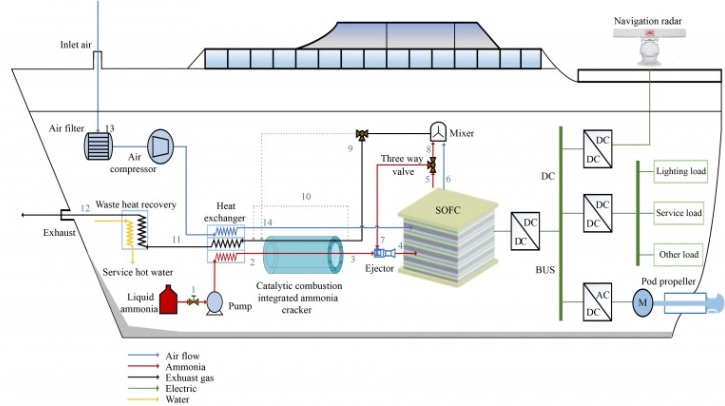
A topological diagram of an NH3-fueled, SOFC powered all-electric propulsion system
Topological diagram of an NH3-fueled, SOFC powered all-electric propulsion system. Credit: Higher Education Press
Share
LinkedIn Twitter Facebook Email

Researchers from the China-UK Low Carbon College at Shanghai Jiao Tong University, in collaboration with the Energy Institute at University College London (UCL) and the School of Mechanical Engineering at Shanghai Jiao Tong University, have unveiled a solid oxide fuel cell (SOFC) system powered by ammonia (NH3) for all-electric ships.

Fuel cell prototyping

The study tackles the technical challenges of NH3 fuel SOFC ship power systems, including slow hydrogen production, low efficiency and limited space. The researchers have introduced a ribbed catalytic combustion-integrated ammonia cracker (IAC) for rapid hydrogen production, which is key for efficient NH3 decomposition into high-concentration H2. The system is designed to be adaptable to various sailing conditions and is validated using a 2kW prototype experimental rig.

The NH3-fueled SOFC system is designed for a target ship with a rated power of 96kW and an electrical efficiency of 60.13%, meeting the requirements for rated cruising conditions. The IAC, measuring 1.1m in length, achieves complete NH3 decomposition within 2.94 seconds, representing a 35% reduction in cracking time and a 42% decrease in required cabin space. The system’s efficiency can be further optimized by adjusting the circulation ratio (CR) and ammonia-oxygen ratio (A/O) under high-load voyage conditions, the researchers state.

Experimental results

The error for NH3 cracking H2 is less than 3% within the range of 570–700°C, which is relevant to typical ship operation scenarios. At 656°C, the NH3 cracking H2 rate reaches 100%. Under these conditions, the SOFC produces 2.045kW of power with an efficiency of approximately 58.66%. The noise level detected is 58.6dB, while the concentrations of CO2, NO and SO2 in the flue gas approach zero, demonstrating the system’s minimal environmental impact.

This research is expected to support the development of NH3-fueled SOFC power systems for ships.

In related news, Wärtsilä Gas Solutions and marine energy infrastructure company Höegh Evi recently completed development of what they state is the world’s first floating ammonia-to-hydrogen cracker. Read the full story here

Share. Twitter LinkedIn Facebook Email
Previous ArticleHGK Shipping holds naming ceremony for Blue Marlin diesel-electric canal vessel
Next Article eCap Marine to provide hydrogen fuel cell propulsion solutions to Samskip and Møre Sjø vessels

Related Posts

Power and Propulsion

Princeton University tests Kilo Hydro at Mercury Racing’s Lake X

March 24, 20263 Mins Read
New Vessels

AET and Fleetzero to develop world’s longest-range hybrid-electric vessel

March 16, 20262 Mins Read
Power and Propulsion

Orange Marine selects ABB power, propulsion and automation systems for new cable repair vessels

March 12, 20263 Mins Read
Latest News

Bureau Veritas classes two advanced high-speed all-electric trimarans

March 24, 2026

Princeton University tests Kilo Hydro at Mercury Racing’s Lake X

March 24, 2026

Joint study shows path to green ammonia cost parity

March 19, 2026

Receive breaking stories and features in your inbox each week, for free


Enter your email address:


Supplier Spotlights
  • Ingeteam
Getting in Touch
  • Contact Us / Advertise
  • Meet the Editors
  • Media Pack
  • Free Weekly E-Newsletter
Our Social Channels
  • LinkedIn
UKi Media & Events
© 2026 UKi Media & Events a division of UKIP Media & Events Ltd
  • Terms and Conditions
  • Privacy Policy
  • Cookie Policy
  • Notice & Takedown Policy

Type above and press Enter to search. Press Esc to cancel.