

Close Menu
Advanced Maritime Technology International
  • News
    • A-M
      • Battery Technology
      • Environmental
      • Equipment and Services
      • Expo
      • Ferries and Cruises
      • Marine Construction
      • Marine Renewables
    • N-Z
      • Naval Projects
      • Onboard Systems
      • Ports and Harbours
      • Power and Propulsion
      • Shipyards and Shipbuilding
      • Vessel Build and Maintenance
  • Features
  • Online Magazines
  • Opinion
  • Videos
  • Supplier Spotlight
LinkedIn Facebook X (Twitter)
  • Sign-up for Free Weekly E-Newsletter
  • Meet the Editors
  • Contact Us
  • Media Pack
LinkedIn
Subscribe
Advanced Maritime Technology International
  • News
      • Alternative Fuels
      • Autonomous Technology
      • Awards
      • Battery Technology
      • Expo
      • Ferries and Cruises
      • Hydrogen
      • Legislation
      • Motor Technologies
      • New Vessels
      • Onboard Systems
      • Ports and Harbours
      • Power and Propulsion
      • Shipyards and Shipbuilding
      • Vessel Design
  • Features
  • Online Magazines
    1. January 2026
    2. September 2025
    3. April/May 2025
    4. January 2025
    5. September 2024
    6. April 2024
    7. Archive Issues
    8. Subscribe Free!
    Featured
    December 4, 2025

    In this issue – January 2026

    Online Magazines By Web Team
    Recent

    In this issue – January 2026

    December 4, 2025

    In this issue – September 2025

    August 6, 2025

    In this issue – April/May 2025

    May 14, 2025
  • Subscribe
  • Opinion
  • Videos
  • Awards
    • Electric & Hybrid Marine Awards 2025 – Nominations open
    • 2024 Winners
    • 2023 Winners
    • 2022 Winners
    • Previous Winners
  • Supplier Spotlight
  • Expo
LinkedIn Facebook
Subscribe
Advanced Maritime Technology International
Battery Technology

Solid-state batteries edge closer

Lawrence ButcherBy Lawrence ButcherJune 10, 20202 Mins Read
Share
LinkedIn Twitter Facebook Email

Solid-state batteries are regularly mooted as an alternative to traditional lithium-ion battery technology. In such batteries, liquid electrolyte material, which can be a source of instability in cells, is replaced by a solid medium.

Solid state technology would be particularly attractive in marine applications, where the risk of fire on board vessels is a major consideration (see the latest issue of EHM for details on the Norwegian ferry Ytteroyningen which suffered a battery room fire).  Unfortunately, no manufacturer has managed to produce a production-ready solid-state solution that can match the energy and power density of current lithium-ion cells, or provide a long service life.

Many are working on these issues. For example, Samsung recently unveiled a solid-state battery system using a silver-carbon composite layer as an anode, which proved much more stable than lithium (one of the major issues with solid-state lithium batteries is dendrite growth between anode and cathode).

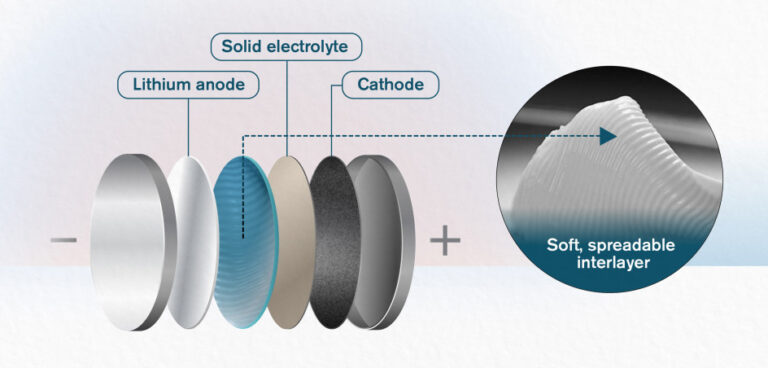
Now, researchers at Chalmers University of Technology, Sweden, and Xi’an Jiaotong University, China, have announced the development of a new interlayer material – which separates the lithium anode, solid electrolyte and whatever cathode material is being used.

Why is such a layer necessary?  Simply put, a solid-state battery can be likened to a dry sandwich. A layer of the lithium is the slice of bread, and a ceramic electrolyte is laid on top like a filling. But the ‘sandwich’ is so dry, it is difficult to keep it together – and there are also problems caused by the compatibility between anode/cathode and the electrolyte.

The material researchers in Gothenburg and Xi’an are now working with is a soft, spreadable substance, made of nanoparticles of the ceramic electrolyte LAGP, mixed with an ionic liquid. The liquid encapsulates the LAGP particles and makes the interlayer soft and protective. The material, which its developers say has a similar texture to butter from the fridge, fills several functions and can be spread easily. The main benefit of its use is that it ensures greater stability between the metallic lithium in the cell and the electrolyte – in this case a NASICON (Sodium Super Ionic Conductor) – providing high ionic conductivity but reducing reactivity between the lithium and electrolyte.

The technology has yet to be made production ready, but it is another encouraging step on the road toward solid state batteries, which will benefit both the marine and other hybrid/EV industries.

Share. Twitter LinkedIn Facebook Email
Previous ArticlePort of Oslo orders hybrid patrol boat
Next Article Innovative water-jet propulsion system undergoes field tests

Related Posts

Vessel Build and Maintenance

UECC orders two multi-fuel battery-hybrid PCTCs

March 9, 20263 Mins Read
Battery Technology

AYK Energy to supply battery system for Germany’s next Polarstern research vessel

March 4, 20262 Mins Read
Battery Technology

Kongsberg Maritime to deliver integrated technology package for LS Marine Solution’s advanced cable laying vessel

February 25, 20263 Mins Read
Latest News

Bureau Veritas classes two advanced high-speed all-electric trimarans

March 24, 2026

Princeton University tests Kilo Hydro at Mercury Racing’s Lake X

March 24, 2026

Joint study shows path to green ammonia cost parity

March 19, 2026

Receive breaking stories and features in your inbox each week, for free


Enter your email address:


Supplier Spotlights
  • Freudenberg e-Power Systems
Getting in Touch
  • Contact Us / Advertise
  • Meet the Editors
  • Media Pack
  • Free Weekly E-Newsletter
Our Social Channels
  • LinkedIn
UKi Media & Events
© 2026 UKi Media & Events a division of UKIP Media & Events Ltd
  • Terms and Conditions
  • Privacy Policy
  • Cookie Policy
  • Notice & Takedown Policy

Type above and press Enter to search. Press Esc to cancel.