


Close Menu
Advanced Maritime Technology International
  • News
    • A-M
      • Battery Technology
      • Environmental
      • Equipment and Services
      • Expo
      • Ferries and Cruises
      • Marine Construction
      • Marine Renewables
    • N-Z
      • Naval Projects
      • Onboard Systems
      • Ports and Harbours
      • Power and Propulsion
      • Shipyards and Shipbuilding
      • Vessel Build and Maintenance
  • Features
  • Online Magazines
  • Opinion
  • Videos
  • Supplier Spotlight
LinkedIn Facebook X (Twitter)
  • Sign-up for Free Weekly E-Newsletter
  • Meet the Editors
  • Contact Us
  • Media Pack
LinkedIn
Subscribe
Advanced Maritime Technology International
  • News
      • Alternative Fuels
      • Autonomous Technology
      • Awards
      • Battery Technology
      • Expo
      • Ferries and Cruises
      • Hydrogen
      • Legislation
      • Motor Technologies
      • New Vessels
      • Onboard Systems
      • Ports and Harbours
      • Power and Propulsion
      • Shipyards and Shipbuilding
      • Vessel Design
  • Features
  • Online Magazines
    1. January 2026
    2. September 2025
    3. April/May 2025
    4. January 2025
    5. September 2024
    6. April 2024
    7. Archive Issues
    8. Subscribe Free!
    Featured
    December 4, 2025

    In this issue – January 2026

    Online Magazines By Web Team
    Recent

    In this issue – January 2026

    December 4, 2025

    In this issue – September 2025

    August 6, 2025

    In this issue – April/May 2025

    May 14, 2025
  • Subscribe
  • Opinion
  • Videos
  • Awards
    • Electric & Hybrid Marine Awards 2025 – Nominations open
    • 2024 Winners
    • 2023 Winners
    • 2022 Winners
    • Previous Winners
  • Supplier Spotlight
  • Expo
LinkedIn Facebook
Subscribe
Advanced Maritime Technology International
Environmental

CWind launches hybrid Surface Effect Ship

Lawrence ButcherBy Lawrence ButcherFebruary 24, 20213 Mins Read
Share
LinkedIn Twitter Facebook Email

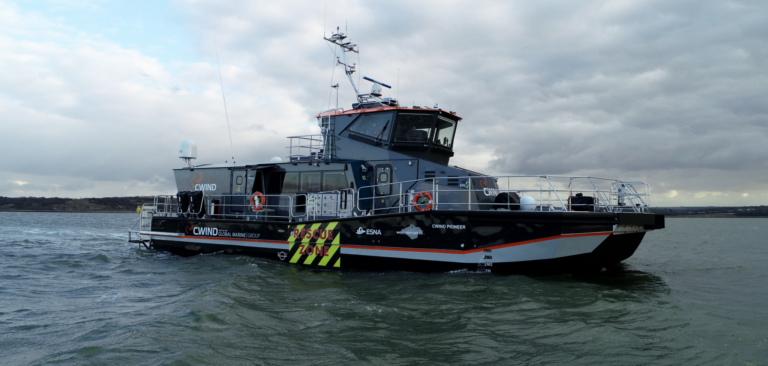
CWind, a provider of project services, CTVs and GWO-accredited training courses to the offshore wind industry, has delivered what it says is the world’s first hybrid-powered Surface Effect Ship (SES), the CWind Pioneer.

The vessel was developed in response to an industry-wide push to deploy innovative technologies that reduce CO2  emissions, while cost-effectively servicing windfarms located further offshore. The company says the Pioneer achieves this through the use of a hybrid diesel and battery-electric power system, enabling the vessel to operate purely on battery power while in harbor or at standby at a windfarm.

With surface effect hull form and heave compensation technology, the CWind Pioneer’s builders state it can operate at speeds exceeding 43.5kts, and can transit and transfer safely in sea states in excess of 1.8m Hs, while minimizing motion and acceleration through its air cushion motion control system. The propulsion system can also deliver sprint speed and extreme bollard push using its 1,600kW diesel engines, which can be battery boosted up to 1,800 kW.

At a speed of 43.5kts, the Pioneer is over 20% more fuel efficient than conventional CTVs running at 24kts on a mile-for-mile basis, CWind says. For a typical windfarm situated 30 nautical miles from port, this translates to a reduction of over 110 tons of CO2  per vessel, per year.

This figure excludes the savings of the hybrid system, which will allow the vessel to be zero-emission ship infield while technicians are carrying out their work on the turbines. The company states that specific figures will be shared once these savings are proven, but initial desktop studies suggest a 30-50% saving over conventional vessels.

Nathanael Allison, managing director, CWind, commented, “The launch of the CWind Pioneer marks a significant milestone for the industry and helps pave the way towards achieving net zero targets. The vessel utilizes revolutionary technology to meet the needs of the market and our customers who want a greener, safer and more efficient Crew Transfer Vessel to support their commercial and green objectives. With the CWind Pioneer we have delivered just that – a new generation of CTVs.”

The vessel will be used at the Borssele 1 and 2 offshore windfarms through a long-term charter contract agreement with Ørsted.

The ship was developed in partnership with ESNA, based in Kristiansand, Norway. ESNA specializes in low-emission technologies and surface effect ship development, and was built by Wight Shipyard, a UK aluminum and high-speed craft vessel builder.

Share. Twitter LinkedIn Facebook Email
Previous ArticleCoalition for the Energy of the Future identifies seven key development projects
Next Article Norwegian electric ferry operator opts for Zinus remote charging

Related Posts

Power and Propulsion

Princeton University tests Kilo Hydro at Mercury Racing’s Lake X

March 24, 20263 Mins Read
New Vessels

AET and Fleetzero to develop world’s longest-range hybrid-electric vessel

March 16, 20262 Mins Read
Power and Propulsion

Orange Marine selects ABB power, propulsion and automation systems for new cable repair vessels

March 12, 20263 Mins Read
Latest News

Bureau Veritas classes two advanced high-speed all-electric trimarans

March 24, 2026

Princeton University tests Kilo Hydro at Mercury Racing’s Lake X

March 24, 2026

Joint study shows path to green ammonia cost parity

March 19, 2026

Receive breaking stories and features in your inbox each week, for free


Enter your email address:


Supplier Spotlights
  • Hydro
Getting in Touch
  • Contact Us / Advertise
  • Meet the Editors
  • Media Pack
  • Free Weekly E-Newsletter
Our Social Channels
  • LinkedIn
UKi Media & Events
© 2026 UKi Media & Events a division of UKIP Media & Events Ltd
  • Terms and Conditions
  • Privacy Policy
  • Cookie Policy
  • Notice & Takedown Policy

Type above and press Enter to search. Press Esc to cancel.