


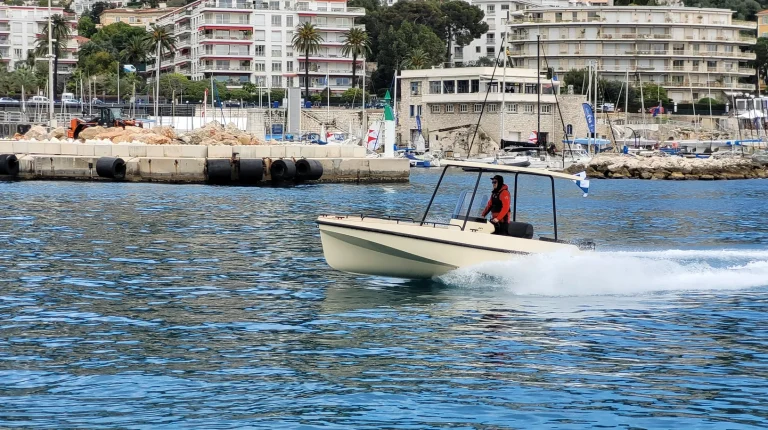
Finnish boatbuilder Elvene has introduced a new solar electric vessel, Amy, which it says is among the fastest solar-powered boats currently in serial production.
Designed and built in Finland, the vessel combines electric propulsion with an integrated solar energy system, targeting private and commercial applications. It is equipped with a 50kW Aries outboard electric drive supplied by Molabo, based on a 48V low-voltage architecture.
According to Elvene, the vessel can reach speeds of up to 30kts. At a cruising speed of 20kts, it offers a range of approximately 35 nautical miles, while at lower speeds it can operate in ‘solar sailing’ mode powered directly by onboard solar generation.
The system includes a battery capacity of up to 45kWh and a solar array rated between 800W and 1,300W. At reduced speeds of up to 5kts, the boat can achieve what the company describes as effectively unlimited range, depending on sunlight conditions.
Elvene CEO Emil Finne said the vessel demonstrates the potential of solar electric propulsion beyond low-speed applications.
“This boat demonstrates that solar electric propulsion is no longer limited to slow displacement speeds,” he stated. “We’re bringing together performance, usability and energy independence in a format that works for real-world boating.”
The propulsion system is supported by Victron energy storage technology, with optional shore power charging available at 3kW. The low-voltage setup is also intended to simplify maintenance and handling compared with higher-voltage systems.
Adrian Patzak, COO of Molabo, said, “Delivering 50kW at 48V enables boatbuilders like Elvene to achieve high performance without the complexity, cost and safety requirements of high-voltage systems.”
The 6.5m vessel is designed for inshore use (CE category C6) and suitable for applications including rental and charter fleets, boat-sharing platforms, private leisure use and tender operations.
Standard features include an integrated infotainment system, chart plotter with echo sounder and wireless phone charging. Optional equipment ranges from a canopy and fridge to a freshwater shower.
Elvene said the combination of planing-speed capability and solar-assisted endurance is intended to address key challenges in marine electrification, including balancing speed, range and operational simplicity.
In related news, Princeton University tests Kilo Hydro at Mercury Racing’s Lake X