

Close Menu
Advanced Maritime Technology International
  • News
    • A-M
      • Battery Technology
      • Environmental
      • Equipment and Services
      • Expo
      • Ferries and Cruises
      • Marine Construction
      • Marine Renewables
    • N-Z
      • Naval Projects
      • Onboard Systems
      • Ports and Harbours
      • Power and Propulsion
      • Shipyards and Shipbuilding
      • Vessel Build and Maintenance
  • Features
  • Online Magazines
  • Opinion
  • Videos
  • Supplier Spotlight
LinkedIn Facebook X (Twitter)
  • Sign-up for Free Weekly E-Newsletter
  • Meet the Editors
  • Contact Us
  • Media Pack
LinkedIn
Subscribe
Advanced Maritime Technology International
  • News
      • Alternative Fuels
      • Autonomous Technology
      • Awards
      • Battery Technology
      • Expo
      • Ferries and Cruises
      • Hydrogen
      • Legislation
      • Motor Technologies
      • New Vessels
      • Onboard Systems
      • Ports and Harbours
      • Power and Propulsion
      • Shipyards and Shipbuilding
      • Vessel Design
  • Features
  • Online Magazines
    1. January 2026
    2. September 2025
    3. April/May 2025
    4. January 2025
    5. September 2024
    6. April 2024
    7. Archive Issues
    8. Subscribe Free!
    Featured
    December 4, 2025

    In this issue – January 2026

    Online Magazines By Web Team
    Recent

    In this issue – January 2026

    December 4, 2025

    In this issue – September 2025

    August 6, 2025

    In this issue – April/May 2025

    May 14, 2025
  • Subscribe
  • Opinion
  • Videos
  • Awards
    • Electric & Hybrid Marine Awards 2025 – Nominations open
    • 2024 Winners
    • 2023 Winners
    • 2022 Winners
    • Previous Winners
  • Supplier Spotlight
  • Expo
LinkedIn Facebook
Subscribe
Advanced Maritime Technology International
Power and Propulsion

Electric power for harbor cleanup vessels

Lawrence ButcherBy Lawrence ButcherJune 19, 20202 Mins Read
Share
LinkedIn Twitter Facebook Email

It’s estimated that 300 million tons of plastic have entered waters around the globe since the 1940s, harming marine life and damaging ecosystems on which humans rely. Harbors are often the last opportunity to intercept plastic before it enters the ocean, where it is much more difficult to remove.

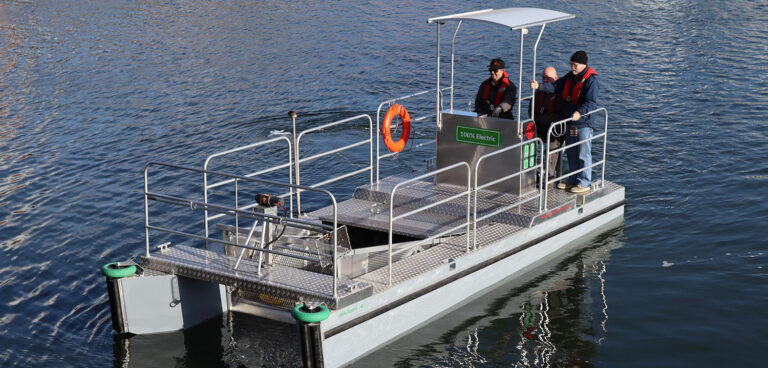
To address this issue, UK company Water Witch has been building specialized cleanup boats for over 50 years. The Liverpool-based boatbuilder has now announced that Torqeedo electric power is to be offered as a replacement for the standard four-stroke outboards on its range of Versi-Cat litter collection craft and pontoon workboats.

“This is a clean, green, safe, zero-emission solution with long life, low maintenance and minimal operating costs,” said Water Witch director Jackie Caddick.

The Torqeedo propulsion package consists of a Cruise 10.0 outboard coupled with two Power 48 intelligent lithium-ion batteries weighing 36kg each. A cockpit control panel gives the operator a view of system status, including range at current speed. The system delivers six to eight hours of service between charges.

“From high-end marinas to commercial harbors and even hydro-electric dams, the environmental benefits of a completely zero-emission solution have really sparked interest,” said Caddick.

“In fact, many of our owners are also enquiring about converting their existing vessels to an all-electric drive. Retrofitting is very easy, basically just a straight swap. It’s a very cost-efficient option, and backed by the support of Torqeedo’s extensive worldwide warranty and after-sales support.”

This year, Water Witch is also introducing a new, larger 8.0m boat to its Versi-Cat series with Torqeedo electric power as standard fit. The new model has traditional hull shape, which is designed to improve transit speeds to 10-11kts using the same propulsion as existing vessels, and provide better seaworthiness for operating in coastal waters.

Caddick believes that electric power will be the future for all of its vessels: “Clients are increasingly looking toward green technology to support their water and waste management services, reduce their dependence on fossil fuels and create a better environment for their own stakeholders. It just makes good sense that a boat working to clean up pollution should not add to the problem by causing pollution in the water or through emissions.”

Share. Twitter LinkedIn Facebook Email
Previous ArticleNew electric ferries commissioned
Next Article Leclanché Energy Storage Solutions for the Maritime Sector

Related Posts

Power and Propulsion

Princeton University tests Kilo Hydro at Mercury Racing’s Lake X

March 24, 20263 Mins Read
New Vessels

AET and Fleetzero to develop world’s longest-range hybrid-electric vessel

March 16, 20262 Mins Read
Power and Propulsion

Orange Marine selects ABB power, propulsion and automation systems for new cable repair vessels

March 12, 20263 Mins Read
Latest News

Bureau Veritas classes two advanced high-speed all-electric trimarans

March 24, 2026

Princeton University tests Kilo Hydro at Mercury Racing’s Lake X

March 24, 2026

Joint study shows path to green ammonia cost parity

March 19, 2026

Receive breaking stories and features in your inbox each week, for free


Enter your email address:


Supplier Spotlights
  • The Switch
Getting in Touch
  • Contact Us / Advertise
  • Meet the Editors
  • Media Pack
  • Free Weekly E-Newsletter
Our Social Channels
  • LinkedIn
UKi Media & Events
© 2026 UKi Media & Events a division of UKIP Media & Events Ltd
  • Terms and Conditions
  • Privacy Policy
  • Cookie Policy
  • Notice & Takedown Policy

Type above and press Enter to search. Press Esc to cancel.